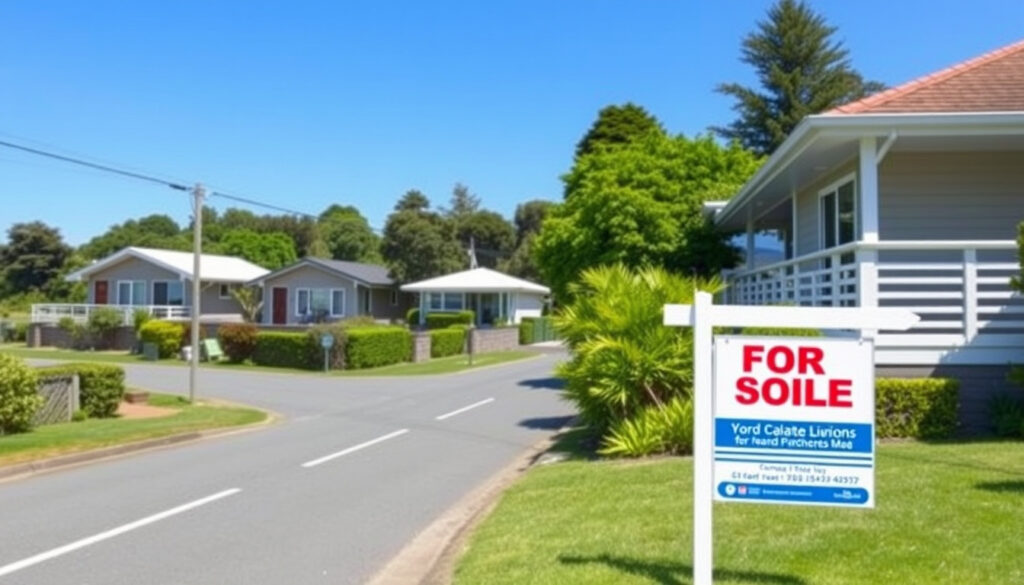
Whangamata Property for Sale: 2025 Market Guide & Prices
Picture a beach town where the surf break is a ten-minute walk from the letterbox and summer is the season everyone waits for — that’s Whangamata, and its property market has a curious edge: median sale prices have dropped 10.3% over the past year, yet holiday-home demand keeps the beachfront premium alive. Here’s what Whangamata property for sale really costs, where the cheaper listings hide, and what to check before you bid.
Average house value (Sep 2026): $1,256,250 (Opes Partners) · Change year on year: −1.65% · Median sale price (12 months): $992,500 · Median asking price: $1,121,000 (realestate.co.nz (national property-listing portal)) · Houses listed on OneRoof: 132 (OneRoof)
Quick snapshot
- Median sale price $992,500 over the last 12 months (realestate.co.nz)
- 132 houses listed on OneRoof (OneRoof)
- Recent sales span $450,000 to $2.6M (Trade Me Property)
- Future price direction — no published forecast
- Exact sub-$600k inventory — portal counts change daily
- Average rental yields — no official Whangamata figure
- Sep 2025: average value around $1,277,000 (Opes Partners) (realestate.co.nz)
- Sep 2026: average value $1,256,250, down 1.65% (realestate.co.nz)
- Asking prices down 6.1% year on year (realestate.co.nz)
- Watch whether sale prices keep sliding below asking
- Spring inventory lifts on OneRoof and realestate.co.nz
- Budget coastal insurance before bidding beachfront
Eight figures, one pattern: every price measure has fallen over the past year, yet the spread between a $434,000 asking price and a $2.299 million listing shows how wide this market really is.
| Measure | Value |
|---|---|
| Average house value | $1,256,250 (Sep 2026, Opes Partners) |
| Year-over-year change | −1.65% |
| Median sale price, last 12 months | $992,500 (realestate.co.nz) |
| Median asking price, last 12 months | $1,121,000 (realestate.co.nz) |
| Active listings on OneRoof | 132 (OneRoof) |
| Sold properties via Ray White | 42 (Ray White Whangamata) |
| Lowest asking price observed | ≈$434,000 (realestate.co.nz) |
| Highest listing observed | ≈$2,299,000 (OneRoof) |
What is the average property price in Whangamata?
Two different measures tell the story, and both point the same way: prices have cooled.
Current average house value
- Opes Partners’ market report put the average house value at $1,256,250 in September 2026.
- realestate.co.nz’s Whangamata insights page shows a median sale price of $992,500 over the last 12 months.
- The same page records a median asking price of $1,121,000 over the same period.
The gap between those numbers isn’t a typo. “Average house value” is a modelled estimate that smooths the whole housing stock, while “median sale price” reflects the middle point of what actually changed hands in the past year. Whangamata has enough unit and townhouse sales to pull the sale median well below the modelled average.
Whichever measure you use, the direction is the same: down. The Opes Partners estimate fell 1.65% year on year, while realestate.co.nz’s median sale price dropped 10.3% and its median asking price fell 6.1%.
The correction is real but uneven: median sale prices fell 10.3% while the strongest beachfront homes still cleared $2.6 million. Buyers have negotiating room on most listings — and almost none on rare Esplanade frontage.
The implication: asking prices in Whangamata have become a starting point, not a floor. The longer a listing sits, the more room there is to negotiate toward the sale-price evidence.
Price trends over the past year
- Median asking price $1,121,000, down 6.1% year on year (realestate.co.nz insights)
- Median sale price $992,500, down 10.3% year on year (realestate.co.nz insights)
- Asking prices now sit roughly 11% above actual sale prices
Five recent sales on Trade Me Property show the range in one glance: units under $700,000, family houses between $1.8M and $2.25M, and Esplanade frontage clearing $2.6M.
| Address | Type | Sold price |
|---|---|---|
| 22/415 Port Road | 2-bedroom unit | $450,000 |
| 1/105G Aickin Road | 2-bedroom, 1-bathroom | $699,000 |
| 309 Beach Road | 4-bedroom, 2-bathroom | $1,800,000 |
| 526 Martyn Road | 3-bedroom, 3-bathroom | $2,250,000 |
| 209A Esplanade Drive | 4-bedroom | $2,600,000 |
Push the two medians together and the bargaining picture becomes clear: the median asking price sits about 11% above the median sale price. Sellers have been slower to drop their expectations than the data says the market already has.
Are there cheap properties for sale in Whangamata?
Yes — if you define “cheap” carefully. The lowest asking prices in Whangamata start well below the median, but they come with trade-offs.
Lowest price listings
- $434,000 — one of the lower-priced listings on realestate.co.nz (national property-listing portal) when we checked.
- $450,000 — what a two-bedroom unit at 22/415 Port Road sold for on Trade Me Property.
- $460,000 — asking price for a section at 17 Governors Heights on Ray White Whangamata (local agency office).
- $630,000 — asking price for a two-bedroom property at 17/16 Campbell Close, on the same realestate.co.nz page.
- $789,000 — the lowest-priced house on Harcourts Whangamata (real-estate agency)‘s office page.
The pattern: under $600,000 you’re looking at units, townhouses and bare sections. A freestanding house on a full site generally starts around $789,000, and even that usually means a smaller floorplan or a location a short drive from the beach.
Tips for finding bargain properties
- Set price-cap alerts on realestate.co.nz, Trade Me and OneRoof — $600,000 for units, $800,000 for houses.
- Watch units in managed complexes; the Port Road unit that sold for $450,000 is exactly the kind of listing that appears and disappears within days.
- Ask agents about pre-listing stock. Offices like Ray White Whangamata and Harcourts Whangamata often know about properties before they hit the portals.
- Cross-check sold prices on Trade Me to spot listings that have been on the market too long.
One warning about portal counts: realestate.co.nz’s insights page recorded 36 active Whangamata listings in its most recent month, while its sold-properties page displayed 130 active sale results. The same town, two very different inventory numbers — the difference is page definition and capture date, not the market itself.
How do I find Whangamata properties for sale?
Whangamata’s for-sale stock is scattered across national portals and local agency sites. The good news: you can scan all of it in an afternoon.
Online portals: Trade Me, OneRoof, realestate.co.nz
- OneRoof (property search and sales-data platform) showed 132 houses in its Whangamata search at last check — filtered to houses only, that drops to 99.
- realestate.co.nz tracks Whangamata listings and market insights on a dedicated page, showing how inventory shifts month to month.
- Trade Me Property’s Whangamata page mixes active listings with recent sales, which makes it a useful second screen for checking asking prices against what sold.
- Harcourts Whangamata (real-estate agency)’s office page carried 19 properties, including houses, apartments, townhouses and land.
Local real estate agencies (Ray White, Harcourts)
- Ray White Whangamata’s office page shows current listings and recorded sales, including the $460,000 section at 17 Governors Heights.
- Harcourts Whangamata lists local houses, sections, apartments and townhouses on a single office page.
- Both agencies carry off-market knowledge — a phone call can surface a property that never reaches a portal.
For a small beach town, Whangamata has a professional agency scene. Ray White’s office page is the one to watch for entry-level stock, while Harcourts tends to carry a broader mix of property types.
Off-market and private sales
Inventory numbers on portals disagree wildly. realestate.co.nz listed 36 new Whangamata listings in its latest month, yet its sold-properties page still displayed 130 active sale results — a reminder that listing counts are a snapshot, not a trend line.
- Most Whangamata sales go through agencies; true private sales are uncommon but do appear in local community Facebook groups and noticeboards.
- For by-owner listings, ask at local cafés and surf shops — in a town this size, word of mouth still works.
- New listings spike in spring; if you’re not in a hurry, setting a saved search now catches the October wave.
Why this matters: Whangamata’s supply is spread across at least five platforms, and no single site shows the full picture. Cross-check OneRoof, realestate.co.nz and an agency page, and you’ll have a realistic count of what’s actually for sale.
Is Whangamata property a good investment?
The honest answer: it depends on your horizon and your tolerance for coastal costs. This is a market that rewards patient buyers and punishes anyone who pays list price without checking the sold data.
Pros: beach lifestyle, holiday demand, infrastructure growth
- Beachfront demand is intact: 209A Esplanade Drive sold for $2.6 million through Trade Me Property.
- Holiday-let demand supports revenue across the peak season, which helps offset holding costs.
- The town’s reputation as a Coromandel surf destination keeps a steady flow of second-home buyers coming back.
The lifestyle premium is the real asset. Whangamata isn’t a speculative development play — it’s a mature beach town where people buy because they want to use the place, not just hold the title.
Cons: price decline, seasonal market, insurance costs
- The median sale price fell 10.3% year on year on realestate.co.nz — a genuine buyer’s market.
- The median asking price is down 6.1%, meaning sellers are still adjusting expectations.
- OneRoof’s 132 listings give buyers a wide choice and weakens any urgency to overbid.
- Coastal insurance and council rates add recurring costs that don’t show in the listing price.
Buying into a falling market gives you a lower entry price, but it also means accepting that prices may fall further. The 10.3% annual drop hasn’t yet found a clearly published floor.
The seasonal rhythm matters more here than in a city suburb. Summer stock sells faster and can attract multiple bids; winter listings sit longer and invite negotiating. If you need to sell in July, you may be waiting until spring for the right buyer.
If you’re weighing a Whangamata purchase against city property, Pacific Watch’s Mount Eden Property for Sale guide shows how an Auckland suburb is pricing right now — a useful counterpoint to the beach-town numbers.
What is the rental market like in Whangamata?
Whangamata’s rental market runs on two engines: long-term locals and short-stay holiday visitors. The two don’t mix as cleanly as in a city.
Rental availability and typical rents
The sub-$700,000 stock that feeds the long-term rental pool is small — think units recently sold or listed below that mark. Most beachfront homes shift into holiday letting, which shrinks long-term supply in summer.
- Long-term rentals are scarce at the height of summer, when owners chase nightly holiday rates.
- Two-bedroom units make up the lower end of the rental market; fully furnished beach houses sit at the top.
- There is no official published rental-yield average for Whangamata, so investors should estimate from real listings.
Investing in rental property
- The entry-level unit market (sub-$700,000) doubles as rental stock — buyers who inspect these units will see which ones are configured for tenants and which for holiday guests.
- Holiday letting can generate strong summer income, but it brings turnover, cleaning costs and management fees.
- Properties within walking distance of the surf club and town centre draw the steadiest enquiry.
For an investor, the arithmetic is different from Auckland’s: a lower purchase price means a smaller deposit, but seasonal vacancy means income arrives in spikes. If you’re comparing the two markets, Pacific Watch’s Trade Me Rentals Auckland guide gives the city-side benchmark.
The implication: buy Whangamata rental property with the seasonal cycle in mind, not against it. A unit that rents to holiday guests for January could sit idle through June.
Pros and cons of buying in Whangamata
The checklist version of everything above, for a quick gut check.
Upsides
- Buyer’s market: median sale price down 10.3% year on year (realestate.co.nz insights)
- Beachfront premium holds — $2.6M at 209A Esplanade Drive (Trade Me Property)
- Entry-level units from $450,000 (Trade Me Property)
- Holiday-let demand around the surf and beach strip
Downsides
- Asking prices still sliding — down 6.1% year on year (realestate.co.nz insights)
- 132 listings on OneRoof give buyers leverage and sellers competition
- Coastal insurance and rates add recurring costs
- Seasonal rental income with winter gaps
The balance: Whangamata rewards buyers who treat it as a long-term beach asset, not a fast flip — the correction is the opportunity, the insurance bill is the tax.
How to buy a property in Whangamata: step by step
The process is standard New Zealand conveyancing, with a few coastal twists.
- Get mortgage pre-approval. Banks will want a 20% deposit for the best rates; some lenders accept less with low-equity fees. A pre-approval sets your ceiling before you browse.
- Build a data baseline. Check realestate.co.nz’s Whangamata insights for the median sale and asking prices, then look at OneRoof’s live listing count to gauge competition.
- Set price-cap alerts. On Trade Me and realestate.co.nz, cap units at $600,000–$700,000 and houses at $800,000–$1.1 million, depending on your budget.
- Inspect for coastal risk. Order a building report and a LIM from the Thames-Coromandel District Council. Check erosion, flood and storm-surge history before auction day — beachfront land is wonderful until it isn’t.
- Study the sales method. Beach-town properties often sell by auction or tender. Ask Ray White or Harcourts for recent comparable sales, and cross-check them on Trade Me’s sold listings.
- Negotiate from evidence. With the median asking price about 11% above the median sale price, the first listed price is a conversation starter, not a target.
- Settle with a local lawyer. Your conveyancer reviews the LIM, title, body-corporate rules (for units) and any coastal covenants before you sign.
Track how many days each listing has been on the market. In a falling market, the line between “new listing” and “still here after six weeks” is where the real buying opportunities appear.
Following these steps gives you a structured approach — each one reduces the risk of a costly surprise.
How the Whangamata market moved in 12 months
- — Average house value holds around $1,277,000 (Opes Partners), near the top of the recent cycle.
- — Opes Partners publishes its 2026 Whangamata market report, putting the average house value at $1,256,250.
- — The average value sits at $1,256,250, down 1.65% year on year; realestate.co.nz’s median sale price shows a sharper 10.3% drop over the same window.
The two series aren’t arguing with each other. The Opes Partners average-value measure smooths the whole stock, while the realestate.co.nz median captures what buyers actually paid in the past year — and the sale data is always the more honest number in a downturn.
What this means: rely on sold prices, not asking prices, to gauge where the market really stands.
What’s confirmed, what’s still unclear
A quick audit of the Whangamata market, divided by confidence level.
- Confirmed — median sale price $992,500 over the last 12 months, down 10.3% (realestate.co.nz insights)
- Confirmed — 132 houses listed on OneRoof (OneRoof)
- Confirmed — recent sales span $450,000 to $2.6M (Trade Me Property)
- Unclear — the future direction of prices; no official forecast covers Whangamata.
- Unclear — the exact number of sub-$600,000 properties at any given moment; portal counts change daily.
- Unclear — average rental yields; no government or industry source publishes a Whangamata figure.
- Unclear — why the Opes Partners average value ($1,256,250) and realestate.co.nz’s median sale price ($992,500) differ so widely; the two measures capture different things at different times.
The gap between the two lists is the risk premium: buyers pricing Whangamata today are betting the correction ends before the beach premium fades.
What the data sources say
“The median sale price in Whangamata over the last 12 months was $992,500, down 10.3% versus the preceding 12 months.”
realestate.co.nz — Whangamata market insights
“Recent sold prices range from $450,000 for a two-bedroom unit at 22/415 Port Road to $2,600,000 for a four-bedroom home at 209A Esplanade Drive.”
Trade Me Property — Whangamata residential sales
“Our Whangamata office listings include a $460,000 section at 17 Governors Heights, and 42 sales have been recorded through the office — entry-level stock is where a lot of the activity sits.”
Ray White Whangamata — office listings
Read together, the sources agree on direction but disagree on magnitude — and that disagreement is exactly why sale-price evidence beats asking-price sentiment.
The takeaway for buyers
Whangamata’s market is mid-correction: sale prices have fallen faster than asking prices, inventory is deep, and the beachfront premium still exists for the rare few who can afford it. For a first-home buyer, the decision is clear: target units and townhouses under $700,000 and negotiate from the sold-price evidence, or keep renting and watch the correction run its course.
The catch: time in the market beats timing the market — if the lifestyle fits, the numbers will follow.
Related reading
- Mount Eden Property for Sale: Complete Buyer’s Guide (2025)
- Trade Me Rentals Auckland: Cheap Houses & Average Rent 2025
whangamata.co, realestate.co.nz, realestate.co.nz, oneroof.co.nz
Frequently asked questions
Can foreigners buy property in Whangamata?
Under New Zealand’s Overseas Investment Act, overseas buyers generally need consent from the Overseas Investment Office to purchase residential land. Australian citizens and Singaporean citizens are exempt. Sort out your eligibility before making an offer.
What is the property tax (rates) in Whangamata?
Rates are set annually by the Thames-Coromandel District Council and vary with capital value, location and services. Ask the vendor for the latest rates notice so you can see the exact annual charge before you bid.
Are there any gated communities in Whangamata?
No. Whangamata is an open beach town — most housing sits on regular streets, and gated residential estates aren’t part of the local market.
How do I get a mortgage for a Whangamata property?
The standard New Zealand process applies: pre-approval from a bank or broker, a deposit of at least 20% to avoid low-equity fees (10% is sometimes possible with lender permission), and a registered valuation that accounts for coastal risk.
What is the school zone for Whangamata properties?
Whangamata Area School covers Years 1–13, making it the town’s main schooling option. Several kindergartens and early-childhood centres serve younger children.
How often do property valuations change in Whangamata?
The Thames-Coromandel District Council revalues properties every three years for rating purposes. Between revaluations, banks rely on registered valuations when you apply for a mortgage.
Are there any upcoming developments in Whangamata?
The district council’s planning documents point toward managed infill growth and upgrades around the town centre. Check the Thames-Coromandel District Council’s district plan for current zones and any open consultations.
More related posts
 What Is a Cold Wallet? How It Works, Top Wallets & Risks
 Zero Alcohol Beer NZ: Health Facts, Myths & Buying Guide
 Things to Do in Napier: Art Deco, Free Attractions & Day Trip
 NZ Drivers Licence Renewal: Online, Overseas & Seniors Guide
 Nintendo Switch Lite NZ: Price & Worth in 2026
 Translate English to Somali: Free Tools for Text, Voice, PDF & Images
 New Zealand Minimum Wage & Benefit Increase 2026: Key Facts
 Orbit 360° Dining Menu: Prices, Worth It? (Auckland 2025)