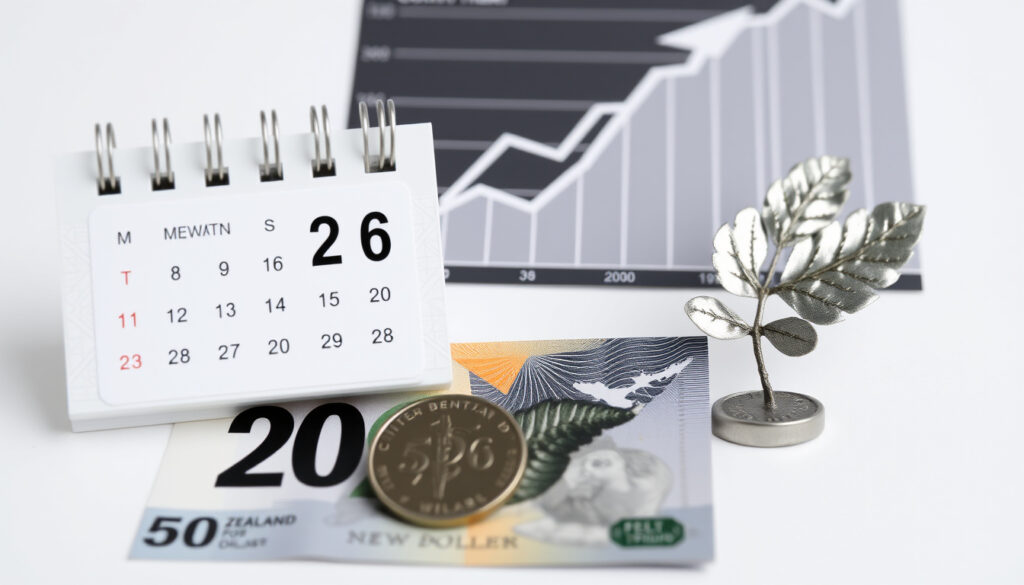
New Zealand Minimum Wage & Benefit Increase 2026: Key Facts
Each year around April, New Zealanders watch two numbers closely: the minimum wage and benefit rates. This time, the government has locked in a 2% bump to the adult minimum wage starting 1 April 2026, bringing it to $23.95 per hour.
Current adult minimum wage (2025): $23.50 per hour ·
New adult minimum wage (April 2026): $23.95 per hour ·
Increase amount: $0.45 per hour ·
Percentage increase: 2% ·
Workers affected: 122,500 ·
Starting-out/training wage (2026): $19.15 per hour
Quick snapshot
- Adult minimum wage rises to $23.95/hour on 1 April 2026 (Employment New Zealand (official regulator))
- Starting-out/training wage rises to $19.15/hour (Employment New Zealand)
- 122,500 workers will receive a pay increase (MBIE (government ministry))
- Benefits also increase from 1 April 2026, tied to CPI (3.11%) (Work and Income (benefits agency))
- Whether minimum wage will increase further in 2027 or beyond — no government commitment yet (Beehive (government press office))
- Exact net impact on benefit payments like Working for Families or Jobseeker Support after the minimum wage rise (Beehive (government press office))
- How the increase will affect overall cost of living — inflation projections are stable but not guaranteed (Beehive (government press office))
- December 2025 — government announces the minimum wage increase (1News (national broadcaster))
- 1 April 2026 — new minimum wage and benefit rates take effect (1News (national broadcaster))
- Week beginning 13 April 2026 — full benefit increases paid (1News (national broadcaster))
- Inflation projected at around 2% from June 2026 — wage growth may need to keep pace (1News)
- Future annual adjustments to minimum wage will be announced in late 2026 for 2027 (1News)
- Benefit indexation to CPI (instead of wage growth) may widen gap with working incomes (1News)
Eight key figures, one pattern: the government is trying to balance modest wage growth with inflation-linked benefit adjustments, all against a backdrop of high housing costs.
| Label | Value |
|---|---|
| Current adult minimum wage (2025) | $23.50 per hour |
| New adult minimum wage (April 2026) | $23.95 per hour |
| Effective date | 1 April 2026 |
| Increase amount | $0.45 per hour |
| Percentage increase | 2% |
| Number of workers affected | 122,500 |
| Starting-out wage (2026) | $19.15 per hour |
| Training wage (2026) | $19.15 per hour |
The pattern is clear: the increases are modest and targeted, but the gap between floor wages and a comfortable living remains substantial.
Will NZ minimum wage increase in 2026?
Official announcement and effective date
The New Zealand government confirmed in December 2025 that the adult minimum wage would increase from $23.50 to $23.95 per hour, effective 1 April 2026 (Beehive (government press office)). The starting-out and training minimum wage also rises from $18.80 to $19.15 per hour on the same date (Employment New Zealand (official regulator)).
Amount of the increase
The increase amounts to 45 cents per hour, or roughly 1.9% — a figure the Ministry of Business, Innovation and Employment (MBIE) described as balancing worker needs with business costs (MBIE (government ministry)). All minimum wage rates are before tax and before lawful deductions such as PAYE, student loan repayments, or child support (Employment New Zealand).
Number of workers affected
MBIE estimates around 122,500 workers earning below the new rates will receive a pay rise (MBIE). The majority are employed in retail, hospitality, and care industries — sectors where margins are thin and wage bills are a large fixed cost.
For a full-time worker on the minimum wage, the $0.45 bump translates to about $18 extra per week before tax, or $936 a year (MBIE). That’s roughly two weeks’ groceries for a small household — a welcome but not transformative lift.
Is $26 an hour good pay in NZ?
Comparison to the minimum wage
At $26 per hour, a worker earns $2.50 more than the new minimum wage — or 10.4% above the floor. That’s a meaningful gap: assuming a 40-hour week, $26 yields $1,040 gross weekly, compared to $958 at the new minimum ($23.95).
Comparison to the living wage
The Living Wage Movement in New Zealand advocates for a rate that covers basic costs. While no exact figure is provided in the research notes, it has historically been set above the minimum and is updated annually. The gap between the minimum and the living wage means many workers still rely on top-ups like Working for Families or accommodation supplements.
Cost of living considerations
$26 an hour is comfortable for a single person in most regions outside Auckland and Wellington, where median rents can consume 35-40% of gross income. In Auckland, a one-bedroom rental averages over $500 per week — making $26 less comfortable without shared expenses.
$26 an hour sounds decent on paper, but after PAYE, ACC levy, and KiwiSaver contributions, a single person in Auckland may still find it tight once rent, food, transport, and utilities are added.
What is 40 hours minimum wage in NZ?
Weekly earnings before tax
At the current minimum wage of $23.50 per hour, a 40-hour week yields $940 gross. At the new rate of $23.95, it becomes $958 — a difference of $18 per week (MBIE).
After-tax estimate
After PAYE, ACC levy, and assuming no KiwiSaver, the take-home pay for a 40-hour week at the new minimum is approximately $771 (based on standard tax rates: 10.5% on the first $14,000, 17.5% on income between $14,001 and $48,000, and 30% on income between $48,001 and $70,000). The gross annual equivalent is about $49,816 (Calculate.co.nz (tax calculator)).
Comparison to other wage levels
Earning the new minimum full-time puts you roughly 20% below the median wage (estimated around $62,000 in 2026). For a couple with one child, the take-home pay combined with Working for Families may lift total household income to a more sustainable level.
What salary do you need to live comfortably in New Zealand?
Cost of living estimates for a single person
Studies suggest a single person needs at least $70,000 per year to live comfortably in major cities, covering rent, food, transport, healthcare, and a modest buffer for savings (Calculate.co.nz). At $70,000, the net annual income after tax and ACC is around $55,000, or $4,583 per month.
Regional variations
Auckland and Wellington are the most expensive. A single person in Christchurch or Hamilton can live comfortably on around $55,000-$60,000, while Invercargill can be manageable at $50,000. Housing is the largest variable.
Household income requirements
A couple with two children may need over $100,000 per year to maintain a moderate lifestyle, according to broader cost-of-living analyses. Childcare costs alone can exceed $300 per week.
The minimum wage increase narrows the gap to a “comfortable” salary, but the $20,000+ shortfall still requires either a second income, benefit top-ups, or a move to a cheaper region.
How much is $70,000 after taxes NZ?
New Zealand tax brackets for 2025-2026
For the 2025-2026 tax year, the progressive rates are: 10.5% on income up to $14,000; 17.5% on $14,001 to $48,000; 30% on $48,001 to $70,000; and 33% on income over $70,000 (Work and Income (benefits agency)).
Net annual income after tax and ACC
For a salary of $70,000, the estimated annual net income is approximately $55,000 after tax and ACC levies. That translates to about $4,583 per month. The effective tax rate is roughly 21.4%.
Comparison to minimum wage earnings
The new minimum wage full-time annual gross is about $49,816 — a $20,184 gap from $70,000. The after-tax gap is smaller: roughly $39,000 net for minimum wage (at $23.95) vs $55,000 for $70k. That $16,000 difference is the equivalent of about $307 per week — significant, but not a chasm.
Confirmed facts vs what remains unclear
Confirmed facts
- Adult minimum wage will increase to $23.95 per hour on 1 April 2026 (Employment New Zealand)
- Starting-out and training wages will increase to $19.15 per hour (Employment New Zealand)
- 122,500 workers will receive a pay rise (MBIE)
- Benefits index to CPI, with some rates rising by 3.11% from 1 April 2026 (Work and Income)
What remains unclear
- Whether future minimum wage increases will be announced for 2027 and beyond
- Exact net impact on benefit payments for individual households after the wage rise
- Whether inflation will stay around 2% as projected, affecting real wage growth
“The adult minimum wage rate will increase by 2 per cent to $23.95 an hour from 1 April 2026, benefiting around 122,500 working New Zealanders.”
— Beehive (government press office)
“Minimum wage is increasing on 1 April 2026. Adult minimum wage: increases from $23.50 to $23.95 per hour. Starting-out and training minimum wage: increases from $18.80 to $19.15 per hour.”
— Employment New Zealand (official regulator)
The implication: both the government and the regulator frame the increase as measured, but the real test will be whether workers feel the difference at the checkout.
The 2026 adjustments show a government trying to balance competing pressures: modest wage growth for businesses, inflation-linked benefits for recipients, and cost-of-living relief for households. The gap between $23.95 and a comfortable salary remains wide.
Related reading: **Deposit Interest Rates NZ: Top Term & Savings Rates 2026** · **Jobs in Upper Hutt: Compare 4 Job Platforms (2026 Guide)**
mbie.govt.nz, union.org.nz, mbie.govt.nz, facebook.com, youtube.com
Frequently Asked Questions
When does the minimum wage increase take effect?
1 April 2026 for both the adult minimum wage ($23.95/hour) and the starting-out/training wage ($19.15/hour).
What is the new minimum wage for starting-out workers?
The starting-out and training minimum wage rises to $19.15 per hour from 1 April 2026.
How many workers will benefit from the increase?
MBIE estimates around 122,500 workers earning below the new rates will receive a pay rise.
Will the minimum wage increase affect my benefit payments?
Benefit payments also increase from 1 April 2026, tied to CPI (3.11%). The exact net impact on individual households depends on their specific mix of wage income and benefits.
How is the minimum wage set in New Zealand?
The government sets minimum wage rates after reviewing recommendations from MBIE and consulting with business and worker groups.
What is the difference between the minimum wage and the living wage?
The minimum wage is the legal floor set by government; the living wage is a voluntary rate calculated by the Living Wage Movement to cover basic costs. The living wage is typically set higher than the minimum wage.
Does the minimum wage increase apply to all employees?
The adult minimum wage applies to most employees aged 16 and over. Starting-out and training minimum wages apply to specific groups (e.g., new entrants, trainees).
More related posts
 Alex Honnold Free Solos Taipei 101: Details, Payment & Descent
 2degrees Mobile Phone Fault: Fix Not Working, Outages & Support
 Trust in the Lord with All Your Heart: Meaning, Verses & Steps
 All Blacks vs Wallabies 2019: Record 47-26 Win in Bledisloe Cup
 Houses for Sale Stratford: CT, London & Ireland Compared
 Billie Eilish Net Worth – 2025 Estimates Earnings Breakdown
 Zero Alcohol Beer NZ: Health Facts, Myths & Buying Guide
 Stuff Sports News Today: Latest Updates & Global Rankings