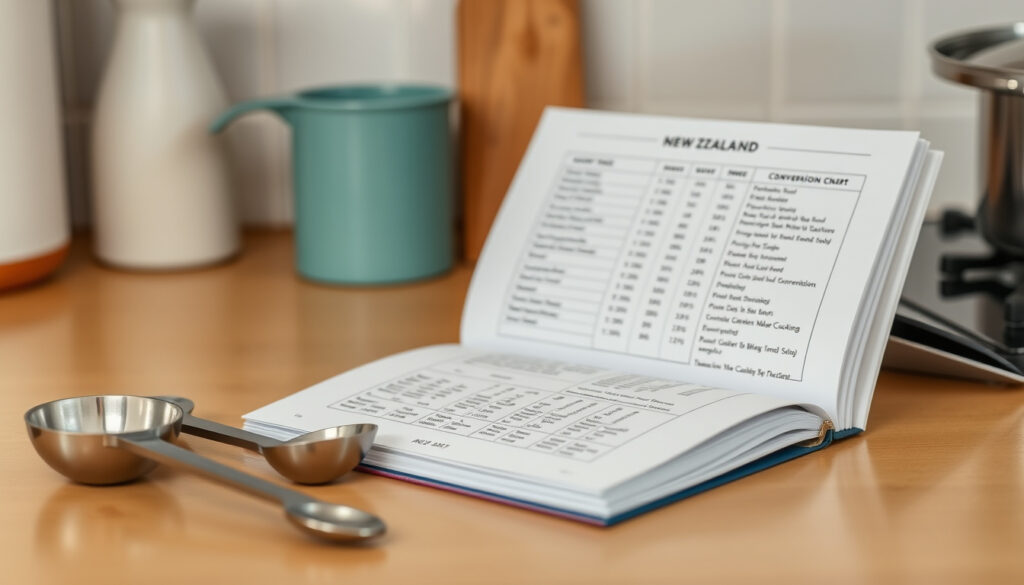
How Many Teaspoons in a Tablespoon in NZ? Conversion Guide
If you’ve ever stood in your kitchen, recipe in hand, you know the question: how many teaspoons in a tablespoon? In New Zealand, the answer is straightforward — 3 teaspoons make 1 tablespoon, based on metric volumes of 15 ml and 5 ml respectively.
1 tablespoon (NZ standard): 3 teaspoons = 15 ml ·
1 teaspoon (NZ standard): 5 ml ·
Australian tablespoon: 4 teaspoons = 20 ml ·
1 dessertspoon (NZ): 10 ml ·
1 cup (NZ standard): 250 ml
Quick snapshot
- NZ standard tablespoon = 15 ml = 3 tsp (Chelsea Sugar – How to Convert Measurements)
- NZ standard teaspoon = 5 ml (Nutrition Foundation of New Zealand – Cooking Measures)
- Australian tablespoon = 20 ml = 4 tsp (AS 1325-1997 – Measuring cups and spoons for domestic purposes)
- NZ metric cup = 250 ml (BakeClub – What Size Is Your Tablespoon Measure?)
- Whether older NZ recipes or imported Australian ones use the 20 ml tablespoon
- Exact weight of a teaspoon of flour depends on scooping method
- NZ standard tablespoon (15 ml) has been consistent since metric adoption; no recent change
- More recipes are calling out metric volumes explicitly, reducing confusion
NZ standard tablespoon = 15 ml = 3 tsp
Chelsea Sugar – How to Convert Measurements
NZ standard teaspoon = 5 ml
Nutrition Foundation of New Zealand – Cooking Measures
The table below summarizes key volume conversions for New Zealand and Australia.
| Measurement | Value |
|---|---|
| NZ standard tablespoon | 3 teaspoons = 15 ml |
| NZ standard teaspoon | 5 ml |
| Australian tablespoon | 4 teaspoons = 20 ml |
| NZ dessertspoon | 10 ml |
| NZ metric cup | 250 ml |
| 1 cup in tablespoons | 16 tbsp (NZ) |
How many teaspoons in a tablespoon in New Zealand?
The answer is 3. In New Zealand, 1 tablespoon equals 3 teaspoons, and that tablespoon holds 15 ml. This is the standard used across the UK and the US as well, according to the Chelsea Sugar conversion guide (authoritative NZ baking resource). The Nutrition Foundation of New Zealand (NZ health education body) confirms the same: 3 teaspoons = 1 tablespoon = 15 ml.
Why is the conversion 3 teaspoons per tablespoon?
- Because the metric system defines 1 teaspoon as 5 ml. Three times that gives 15 ml — the standard tablespoon volume.
- This 1:3 ratio makes scaling recipes simple. If a recipe calls for 4 tablespoons, you know that’s 12 teaspoons or 60 ml.
The New World conversion chart (NZ supermarket resource) lists 1 teaspoon = 5 ml and 1 tablespoon = 15 ml, reinforcing this ratio for home cooks.
Does the conversion change for Australian or UK recipes?
- UK recipes use the same 3 tsp = 1 tbsp = 15 ml standard as New Zealand.
- Australian recipes are the exception: 1 Australian tablespoon = 4 teaspoons = 20 ml, as defined by AS 1325-1997 (Australian domestic measuring standard).
This means if you’re following an Australian recipe in a New Zealand kitchen, every tablespoon listed is 5 ml larger than your NZ spoon. The Edmonds/Langbein conversions (NZ chef and baking authority) explicitly warn that Australian tablespoons are larger at 20 ml.
The implication: always verify the recipe’s origin before measuring, especially with Australian sources.
Is a tablespoon 15 or 20 ml?
For New Zealand, it’s 15 ml. But the 20 ml Australian tablespoon creates real confusion. The Milly’s Kitchen baking guide (NZ home-baking resource) notes that the Australian tablespoon should not be assumed interchangeable with NZ measures.
Why are there two different tablespoon sizes?
- When Australia adopted the metric system, it set its tablespoon at 20 ml instead of 15 ml.
- New Zealand, the UK, and the US all settled on 15 ml.
- The Australian standard AS 1325-1997 (official domestic measuring standard) formalizes the 20 ml tablespoon, cementing the difference.
How to convert between 15 ml and 20 ml tablespoons
- If an Australian recipe says 1 tbsp, use 4 tsp (20 ml) from an Australian spoon set — or use 1 NZ tbsp + 1 NZ tsp (15 ml + 5 ml = 20 ml).
- If you only have a NZ 15 ml spoon, multiply Australian tablespoon amounts by 0.75 to get the correct volume.
- For example: 4 Australian tbsp (80 ml) = 3 NZ tbsp (45 ml) + 1 NZ tbsp + 1 NZ tsp (20 ml) = 5 NZ tbsp and 1 tsp total.
New Zealand cooks who use Australian recipes without adjusting their tablespoon measure risk adding 33% more volume per spoonful — enough to throw off baking ratios significantly.
The Reward Hospitality cooking guide (Australian hospitality resource) confirms the Australian tablespoon as 20 ml and the teaspoon as 5 ml, reinforcing the divide.
What does 1 tablespoon look like on a spoon?
Visual comparison helps. A tablespoon is roughly the size of a soup spoon, a teaspoon is about half that size, and a dessert spoon sits between them.
How does a tablespoon compare to a teaspoon?
- A tablespoon holds three times the volume of a teaspoon, but visually it’s about twice as long and slightly wider.
- The bowl of a tablespoon holds roughly the same volume as a whole soup spoon.
How does a tablespoon compare to a dessert spoon?
- A New Zealand dessert spoon holds 10 ml — two-thirds of a tablespoon’s 15 ml.
- If a recipe calls for a tablespoon and you use a dessert spoon, you’ll be under-measuring by one-third.
The Chelsea Sugar baking guide (NZ baking authority) lists the dessert spoon as 10 ml, confirming its intermediate role.
A common mistake is using a serving tablespoon (the large spoon you eat soup with) as a measuring tablespoon. A serving spoon can hold 20–30 ml, easily double a standard NZ tablespoon.
The pattern: visual size does not always match volume, so rely on marked measures.
How many teaspoons in a cup in New Zealand?
One New Zealand metric cup equals 250 ml. That’s 48 teaspoons or 16 tablespoons. The Lighthouse Flour conversion guide (Australian baking resource) notes that both Australia and New Zealand use the 250 ml metric cup.
How many tablespoons in a cup?
- 1 cup = 16 tablespoons (based on the 15 ml NZ tablespoon).
- 1/2 cup = 8 tablespoons.
- 1/4 cup = 4 tablespoons.
How many ml in a cup?
- 1 cup (NZ) = 250 ml.
- 1/2 cup = 125 ml.
- 1/4 cup = 60 ml (rounded).
This consistency means scaling recipes up or down is straightforward, as long as you’re using the same standard throughout.
When a recipe calls for “1 cup of flour,” using a 250 ml cup versus a 240 ml US cup adds 4% more flour. For baking that depends on precise ratios, that difference matters.
The implication: always confirm which cup standard your recipe uses.
How many grams in a teaspoon in New Zealand?
Volume-to-weight conversions vary by ingredient. A teaspoon of granulated sugar weighs about 4.2 grams, while a teaspoon of all-purpose flour weighs about 2.6 grams.
How many grams of sugar in a teaspoon?
- 1 teaspoon of granulated sugar ≈ 4.2 grams.
- 1 tablespoon of granulated sugar ≈ 12.6 grams.
- 1 cup of sugar ≈ 200 grams.
How many grams of flour in a teaspoon?
- 1 teaspoon of all-purpose flour ≈ 2.6 grams.
- 1 tablespoon of all-purpose flour ≈ 8 grams.
- 1 cup of flour ≈ 125 grams.
Why weight conversions vary by ingredient
- Different ingredients have different densities — a teaspoon of salt weighs more than a teaspoon of flour.
- Scooping method changes weight: a spooned-and-leveled teaspoon of flour versus a packed teaspoon can differ by 30%.
The implication: for any recipe where precision matters — especially baking — a kitchen scale is more reliable than volume measurements.
The following table illustrates weight variations for common ingredients by volume.
| Ingredient | 1 teaspoon | 1 tablespoon | 1 cup |
|---|---|---|---|
| Granulated sugar | 4.2 g | 12.6 g | 200 g |
| All-purpose flour | 2.6 g | 8 g | 125 g |
| Salt (table) | 5.7 g | 17.1 g | 273 g |
| Butter | 4.7 g | 14.2 g | 227 g |
| Honey | 7.1 g | 21.3 g | 340 g |
The catch: even with the best chart, a scale eliminates guesswork.
How to Convert Australian Recipes to New Zealand Measurements
- Identify the recipe origin — if it’s Australian, the tablespoon is 20 ml.
- Multiply each Australian tablespoon amount by 0.75 to get the equivalent in NZ tablespoons (15 ml).
- Alternatively, replace 1 Australian tablespoon with 1 NZ tablespoon plus 1 NZ teaspoon (15 + 5 = 20 ml).
- Use a digital kitchen scale for dry ingredients to avoid volume inconsistencies.
Related reading: New World – Conversion chart
langbein.com, reddit.com, wellforone.com.au, millyskitchen.co.nz, lighthousebaking.com.au, cooksinfo.com
Frequently asked questions
How many teaspoons in a tablespoon in Australia?
In Australia, 1 tablespoon equals 4 teaspoons because the Australian tablespoon is 20 ml, as defined by AS 1325-1997 (Australian domestic measuring standard).
Can I use a dessert spoon as a tablespoon?
A New Zealand dessert spoon holds 10 ml, while a tablespoon holds 15 ml. Using a dessert spoon as a tablespoon will give you two-thirds the correct volume.
How many ml in a teaspoon in New Zealand?
One New Zealand teaspoon holds 5 ml, according to the Chelsea Sugar conversion guide (NZ baking resource).
What is the difference between a metric tablespoon and an imperial tablespoon?
A metric tablespoon is exactly 15 ml. An imperial tablespoon is about 14.8 ml — so close that the difference is negligible for home cooking.
How many grams of sugar in a teaspoon?
Approximately 4.2 grams of granulated sugar fit in one level teaspoon. This can vary slightly based on crystal size and packing.
How many tablespoons in a cup in New Zealand?
One New Zealand metric cup (250 ml) equals 16 tablespoons, each of 15 ml.
Is a tablespoon the same as a soup spoon?
A measuring tablespoon holds 15 ml, while a typical soup spoon holds around 20–30 ml. They are not interchangeable for accurate measuring.
How do I convert an Australian recipe to NZ measurements?
Multiply Australian tablespoon amounts by 0.75. For every 4 Australian tablespoons (80 ml), use 3 NZ tablespoons (45 ml) plus 1 NZ teaspoon (5 ml) for correct volume.
Related reading
More related posts
 Warriors vs Trail Blazers: Final Score, Stats & Curry Assists
 Ben Roberts-Smith war crimes allegations and trial
 Castlepoint Hotel License Issues: Closure and Backlash
 Khmer Satay Noodle House: Christchurch Menu, Reviews & Info
 Jobs in Upper Hutt: Compare 4 Job Platforms (2026 Guide)
 ANZ Bank Mortgage Calculator: Repayments & Rates Guide
 Stuff Sports News Today: Latest Updates & Global Rankings
 Hastings Girls High School: Principal, Decile, Uniform Guide