Cellulitis of the Leg – Symptoms, Treatment and Recovery
Cellulitis of the leg is a bacterial skin infection that penetrates the deeper layers of skin and soft tissue, most often targeting the lower leg. Bacteria enter through cuts, insect bites, cracks, or wounds, triggering a localised infection characterised by redness, swelling, warmth, and pain. Without treatment, the condition can escalate quickly and, in some cases, become life-threatening.
The lower leg is the most frequently affected site. Prompt antibiotic treatment is required in all confirmed cases — the infection does not resolve reliably without medical intervention, regardless of how mild it appears at first. Delay in treatment is one of the most significant risk factors for complications.
The following sections cover what cellulitis on the leg looks like, what causes it, how it is treated, and how to recognise the warning signs that demand emergency care.
What Are the Symptoms of Cellulitis on the Leg?
| Symptoms | Causes | Treatment | When to Seek Help |
|---|---|---|---|
| Redness, swelling, warmth, and pain; possible red streaks and fever | Bacteria entering via cuts, bites, cracks, or wounds in the skin | Oral or IV antibiotics for 5–14 days; always complete the full course | Rapidly spreading redness, high fever, red streaks, or blistering require urgent review |
- The four core signs are redness, swelling, warmth, and tenderness, typically localised to the infected area of the leg.
- Red streaks extending up the leg along lymph vessels, combined with swollen lymph nodes, indicate the infection is spreading beyond the initial site.
- Systemic signs — fever, chills, and elevated inflammatory markers such as C-reactive protein — signal a more serious infection response.
- In severe cases, blisters, ulcers, sweats, and vomiting may develop alongside the local skin changes.
- Symptoms can worsen during the first 48 hours of antibiotic treatment before beginning to improve; this is a recognised part of the infection’s course.
- A study of 247 leg cellulitis patients found that while inflammation had normalised by day 10, more than half of participants still reported ongoing discomfort at that point.
- Cellulitis is not contagious and cannot be transmitted between people through ordinary contact.
| Fact | Detail |
|---|---|
| Primary bacteria involved | Staphylococcus and Streptococcus species |
| Most common site | Lower leg |
| Onset after skin breach | Hours to days |
| Contagious person-to-person | No |
| Standard antibiotic course (mild–moderate) | 5–10 days oral |
| Initial improvement typically seen | 2–3 days after starting antibiotics |
| Swelling reduction milestone | Approximately 50% by day 10 |
| Full resolution in uncomplicated cases | 7–10 days; 14+ days with complications |
| Elevated inflammatory markers | C-reactive protein commonly raised |
| DVT risk in cellulitis patients | Low — approximately 2–3% overall |
| Recurrence risk | Elevated in lymphedema and weakened immunity |
Visual Signs and How the Infection Progresses
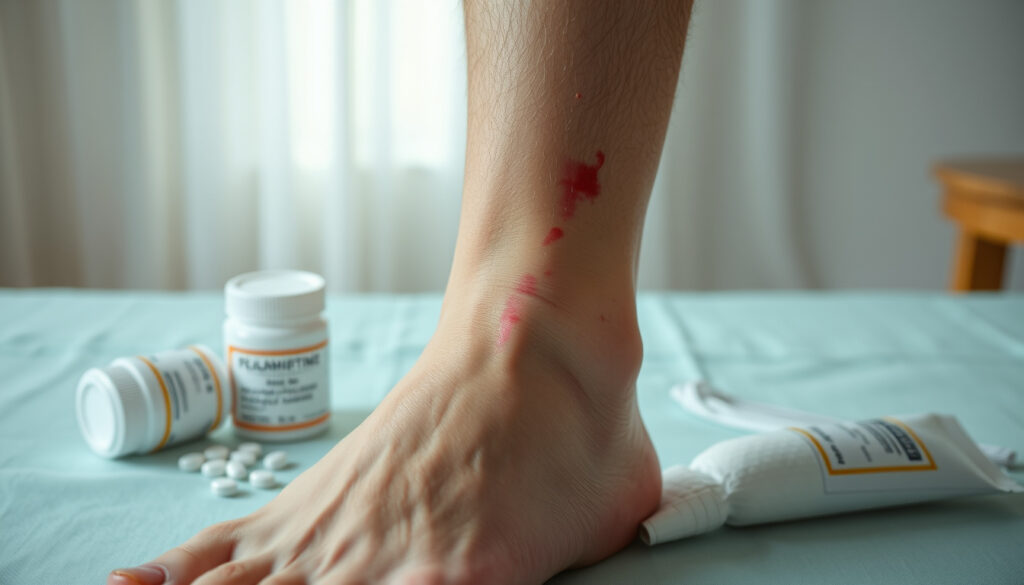
Cellulitis on the leg typically appears as an irregular patch of red, swollen skin that is noticeably warm to the touch. According to the Mayo Clinic, the redness spreads outward as the infection advances, with edges that are often blurred rather than sharply defined.
One clinically important visual feature is that cellulitis-affected skin appears pitted and does not blanch — it remains red when pressure is applied. This differs from the smooth, blanching redness more commonly seen with deep vein thrombosis. Red streaks extending upward from the site of infection are a sign that bacteria are tracking along the lymphatic vessels and that the infection is spreading.
Severe cases may progress to blistering or ulceration on the leg’s surface. These changes indicate a more aggressive infection and should prompt immediate medical assessment rather than observation at home.
Pain, Swelling, and Systemic Indicators
Pain and tenderness are consistent features of leg cellulitis, often described as a deep aching or burning sensation. Swelling in cellulitis typically remains localised to the infected area rather than involving the entire limb — a distinction that helps clinicians differentiate it from DVT, where whole-limb or calf swelling is more characteristic.
Systemic symptoms including fever, chills, and raised inflammatory markers indicate that the body’s immune response has become widespread. Swollen lymph nodes in the groin or behind the knee may accompany lower leg infections. In the most severe presentations, sweating and vomiting reflect a systemic infection response requiring urgent care.
After treatment begins, the Cleveland Clinic identifies reduced redness, swelling, pain, and skin discoloration as the primary markers of recovery to monitor in the days following antibiotic initiation.
How Is Cellulitis on the Leg Treated?
Antibiotics and Medical Care
Antibiotics are the definitive and required treatment for cellulitis of the leg. Mild to moderate infections are typically treated with oral antibiotics for 5 to 10 days. Completing the full prescribed course matters — stopping early when symptoms improve risks incomplete bacterial clearance and increases the chance of recurrence.
Severe infections, including those with rapidly spreading redness, high fever, or signs of systemic illness, require intravenous antibiotics delivered in hospital. According to WebMD, the antibiotic choice is guided by the most probable causative bacteria — Staphylococcus and Streptococcus species are the most frequently implicated.
Symptoms of leg cellulitis commonly worsen during the first 48 hours of antibiotic treatment before beginning to improve. This does not indicate treatment failure. Always complete the full prescribed course as directed by a clinician.
Recovery Timeline and Self-Care
Noticeable improvement — reduced redness, warmth, and pain — typically occurs within 2 to 3 days of starting antibiotics. According to a review by Harvard Health, swelling is reduced by approximately 50% by day 10, with full symptom resolution in uncomplicated cases expected within 7 to 10 days. Complicated infections or those in people with weakened immunity may take 14 days or longer to clear completely.
Residual swelling and discomfort can linger beyond the acute phase as the immune response winds down. The 247-patient leg cellulitis study cited by Harvard Health found that even after inflammation normalised at day 10, more than half of participants still had ongoing discomfort — a pattern that is expected rather than alarming.
Supportive care measures such as elevating the affected leg and resting may help manage swelling and discomfort during recovery. These measures complement antibiotic treatment but do not replace it. No validated standalone home remedy is established in the clinical literature for cellulitis.
What Causes Cellulitis on the Leg?
Common Entry Points for Bacteria
Cellulitis develops when bacteria — most often Staphylococcus or Streptococcus — breach the skin’s protective barrier and invade the underlying tissue. The lower leg is particularly vulnerable because minor injuries there are frequent and may go unnoticed for some time.
Entry points include cuts, scrapes, surgical wounds, insect bites, animal bites, and areas of skin cracked by dryness or fungal infection such as athlete’s foot. Poor injecting technique in people who inject substances can also introduce bacteria directly into the tissue, as documented in clinical resources from Northern Rivers Community Health. Sports-related abrasions on the lower leg are a further recognised pathway — appropriate protective equipment, such as Kids Rugby Boots NZ for younger players, can reduce exposure to the leg skin trauma that creates these bacterial entry points.
In some cases, no obvious break in the skin is found. Microscopic cracks from dry or scaly skin — including those caused by eczema or chronic venous changes — can be sufficient to allow bacterial entry even when no visible wound is present.
Risk Factors Specific to the Leg
Lymphedema — chronic swelling resulting from impaired lymphatic drainage — significantly increases the risk of leg cellulitis and is strongly associated with recurrent episodes. A weakened immune system, whether from illness or immunosuppressive medication, reduces the body’s capacity to contain bacterial spread once infection begins.
Previous episodes of cellulitis in the same limb, underlying skin conditions, and venous insufficiency all contribute to elevated risk. According to Legs Matter, managing these underlying conditions is central to preventing cellulitis from recurring in at-risk individuals.
How Serious Is Cellulitis on the Leg?
Potential Complications
Untreated cellulitis can escalate into sepsis — a life-threatening systemic infection requiring emergency hospitalisation. Locally, severe progression can produce deep ulceration and extensive tissue damage. Even cases that initially appear mild carry this escalation risk without antibiotic treatment.
According to GoodRx, no level of cellulitis should be managed by observation alone without medical assessment. The absence of severe symptoms at presentation does not eliminate the risk of rapid worsening.
Cellulitis of the leg can spread to the bloodstream and cause sepsis if not treated with antibiotics. Even mild-looking infections carry this risk. Observation without medical care is not a safe approach to managing this condition.
Misdiagnosis is an additional complication risk. Cellulitis and deep vein thrombosis share overlapping signs — both present with leg redness and swelling — but require opposite treatments. Treating cellulitis as DVT with anticoagulation, or treating DVT as cellulitis with antibiotics alone, can result in serious patient harm.
Red Flags That Require Emergency Attention
Rapidly expanding redness, red streaks tracking up the leg from the infection site, and the appearance of blisters or dark discoloration in the skin are signs that the infection has become a medical emergency. High fever alongside local skin changes, or systemic symptoms including confusion or vomiting, indicate possible bloodstream involvement.
Go to an emergency department if redness is spreading quickly, red streaks are visible running up the leg, blisters or skin darkening appear, or systemic symptoms such as high fever or confusion develop alongside the infection. These signs suggest potential sepsis.
People with lymphedema or a suppressed immune system are at higher risk of rapid deterioration and should seek medical attention at the first signs of infection rather than waiting for symptoms to worsen before acting.
How Does Cellulitis on the Leg Progress From Onset to Recovery?
- Skin breach occurs — A cut, insect bite, wound, or crack creates a bacterial entry point, most commonly on the lower leg.
- Bacterial invasion begins — Within hours to days, bacteria infiltrate the deeper skin layers; the local immune response is activated.
- Symptoms emerge (24–48 hours) — Redness, swelling, warmth, and pain develop at the site and may begin to spread outward from the entry point.
- Systemic signs may develop — Fever, chills, swollen lymph nodes, and in some cases red streaks along lymph vessels indicate the spread of infection.
- Antibiotic treatment begins — Oral or IV antibiotics are initiated; symptoms may continue to worsen during the first 48 hours before improvement is seen.
- Early improvement (day 2–3) — Redness, warmth, and pain begin to reduce; marking the border of redness at treatment start can help track whether it is receding or advancing.
- Significant improvement (day 7–10) — Swelling is reduced by approximately 50% by day 10; inflammatory markers begin to normalise.
- Full resolution (day 7–14+) — Complete clearing in uncomplicated cases; residual discomfort beyond the acute phase is common, particularly in those with underlying risk factors such as lymphedema.
What Is Established About Leg Cellulitis and What Remains Uncertain?
| Established | Less Certain or Variable |
|---|---|
| Cellulitis is caused by bacterial infection, primarily Staphylococcus and Streptococcus | The specific bacterial species in any individual case may not be confirmed without culture testing |
| Antibiotics are required; oral for mild–moderate, IV for severe presentations | Optimal antibiotic choice varies based on local resistance patterns and individual health factors |
| Initial improvement is expected within 2–3 days of starting antibiotics | Exact healing duration is variable — some patients take 14+ days even with prompt treatment |
| DVT risk in cellulitis patients is low, approximately 2–3% overall | Distinguishing cellulitis from DVT on clinical grounds alone can be difficult and may require compression ultrasound |
| Cellulitis is not contagious between people | Precise recurrence rates in at-risk individuals are not quantified in available sources |
| Untreated cellulitis carries a risk of sepsis and severe local complications | The evidence base for adjunctive home or supportive remedies alongside antibiotics remains limited |
How Does Cellulitis on the Leg Compare to Conditions That Look Similar?
Deep vein thrombosis is the condition most frequently confused with cellulitis in the leg, and accurate differentiation is critical. The two conditions require opposite treatments — antibiotics for cellulitis and anticoagulation for DVT. Administering the wrong treatment risks serious harm in either direction.
The key differences lie in the texture and behaviour of the skin changes and in the pattern of swelling. Cellulitis produces skin that is red, pitted, and non-blanching — remaining red under pressure — and distinctly warmer than surrounding tissue. DVT produces skin that is smooth, may blanch on pressure, and can have a bluish tint. Swelling from cellulitis is localised around the infected area; DVT-associated swelling typically involves the entire limb or calf.
| Feature | Cellulitis | DVT |
|---|---|---|
| Skin texture | Red, pitted, non-blanching, warm | Smooth, blanching red or bluish tint, normal or slightly warm |
| Swelling pattern | Localised to infected area | Whole limb or calf |
| Lymph involvement | Red streaks, swollen nodes present | Lymph signs rare |
| Fever | Common in moderate–severe cases | Low-grade fever possible but less typical |
| Treatment | Antibiotics | Anticoagulation |
A published study reviewed on PubMed found DVT prevalence in cellulitis patients ranging from 1–8% across studies — comparable to DVT rates in low-risk Wells criteria patients. Proximal DVT was found in approximately 2.1% and any DVT in around 3.1% of cellulitis cases. This low overlap means routine ultrasound is not required for every cellulitis presentation, though clinical judgment guides individual decisions.
Erysipelas is a related but distinct condition — a more superficial bacterial skin infection producing a sharply raised, well-demarcated red rash typically on the face or lower leg. Unlike cellulitis, which affects the deeper dermis and subcutaneous tissue, erysipelas involves the upper dermis. Both are treated with antibiotics.
What Do Medical Sources Say About Cellulitis on the Leg?
Major medical institutions are consistent in two core positions: antibiotics are necessary for all clinically confirmed cases, and any deterioration after starting treatment must prompt immediate reassessment rather than continued home management.
“Cellulitis is a common bacterial skin infection that can become life-threatening if not treated. See a doctor right away if you have symptoms of cellulitis.”
— Mayo Clinic, Cellulitis: Symptoms and Causes
“It’s important to treat cellulitis early to prevent the infection from spreading to your bloodstream or other parts of your body.”
— Cleveland Clinic, Cellulitis
Clinical data also establishes that residual symptoms after completing a full antibiotic course are common and do not indicate treatment failure. In the 247-patient leg cellulitis study cited by Harvard Health, more than half of participants still reported discomfort at day 10 despite normalised inflammation markers — a finding that underscores the need to set realistic expectations around recovery time.
Sources focused on leg conditions, including Legs Matter, highlight lymphedema as the dominant driver of recurrent cellulitis. Managing chronic swelling and maintaining skin integrity are identified as the most evidence-supported strategies for individuals who experience repeated episodes.
Can Cellulitis on the Leg Be Fully Cured?
Yes — cellulitis of the leg is a treatable condition, and the vast majority of cases resolve completely with a full course of antibiotics. Most people with uncomplicated infections see full symptom resolution within 7 to 10 days of treatment. Those with lymphedema, suppressed immunity, or a history of recurrent leg infections may face a longer recovery or a higher chance of future episodes. Preventing recurrence centres on managing the underlying conditions that compromise skin integrity — prompt wound care, consistent lymphedema management, and minimising skin trauma remain the most evidence-supported preventive strategies. For anyone experiencing a first episode or noticing a worsening infection, prompt medical assessment remains the essential first step. Those who are regularly active and tracking fitness goals with tools such as a Half Marathon Pace Chart Km should rest the affected limb fully during treatment and obtain medical clearance before resuming strenuous exercise.
Frequently Asked Questions About Cellulitis on the Leg
Is cellulitis on the leg contagious?
No. Cellulitis cannot be transmitted between people through casual contact. It develops when bacteria enter an individual’s own skin through a wound or breach. There is no risk of spreading it to others by touch or proximity.
Are there home remedies that help with leg cellulitis?
No validated home remedies are established in clinical literature for cellulitis. Supportive measures such as elevating the leg and resting may ease swelling and discomfort, but these do not substitute for antibiotic treatment, which is required to eliminate the infection safely.
How can recurrent cellulitis on the leg be prevented?
Prevention focuses on managing underlying conditions such as lymphedema, treating skin wounds promptly, and protecting the skin from injury. People with repeated infections may require longer antibiotic courses or preventive antibiotic therapy, as determined by their clinician.
How is cellulitis on the leg distinguished from a DVT?
Cellulitis produces pitted, non-blanching, warm skin with localised swelling, often accompanied by fever and lymph signs. DVT causes smooth, sometimes bluish skin with whole-limb swelling and fewer systemic signs. Compression ultrasound may be used when DVT cannot be excluded clinically.
When does leg cellulitis require a hospital visit?
Hospital care is needed when redness expands rapidly, red streaks appear on the leg, blisters or skin darkening develop, or systemic symptoms such as high fever, confusion, or vomiting occur. These signs indicate possible bloodstream involvement requiring intravenous antibiotics.
Can cellulitis on the leg resolve without antibiotics?
Reliable resolution without antibiotics is not expected. Even mild cases carry a risk of progressing to serious complications including sepsis. Antibiotic treatment is necessary for all clinically confirmed cellulitis regardless of initial severity.
Why is the lower leg the most commonly affected site for cellulitis?
The lower leg is frequently exposed to minor injuries, insect bites, and skin conditions such as athlete’s foot that compromise the skin barrier. Reduced circulation in the lower limb in some individuals further increases susceptibility to bacterial infection in this area.
More related posts
 Cash for Cars Tauranga: Up to $12,000, Free Towing
 Federal Bureau of Investigation (FBI): Role, Differences & Contact
 Coast to Coast Mangawhai: Health Care & Kitchen Guide
 Book Gift Message for Colleague: Ideas for Every Tone
 Lydia Ko’s Next Tournament 2026: Schedule, Rankings & Retirement
 Bicycle Shop Near Me: Best Dublin Bike Shops Compared
 Alex Honnold Free Solos Taipei 101: Details, Payment & Descent
 Toyota RAV4 Hybrid Ireland: Price, Problems & Best Year to Buy