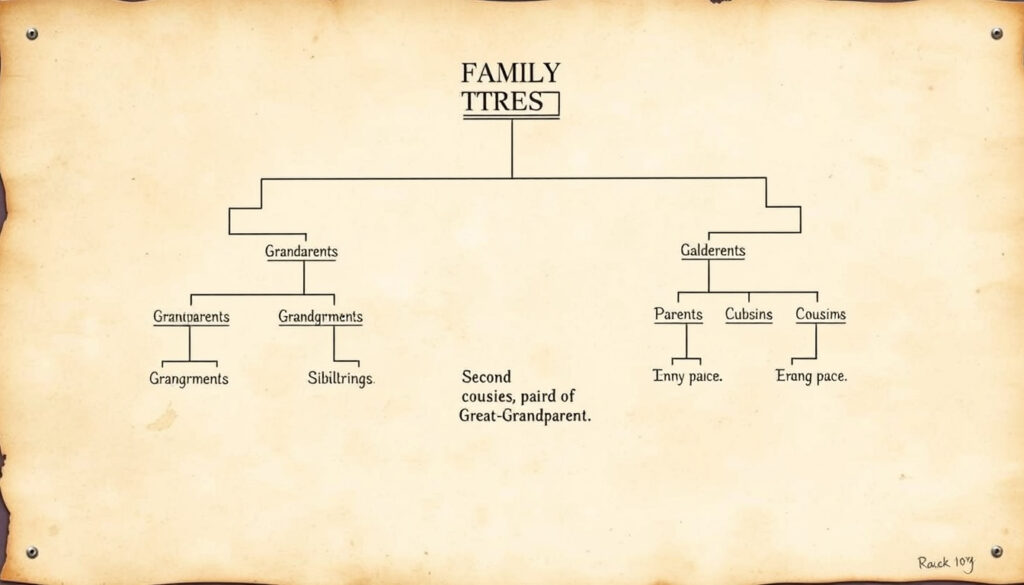
What Is a Second Cousin? Definition, Examples & Family Tree Guide
A family reunion is a sea of familiar faces, but the exact thread that ties everyone together can get fuzzy fast. If you’ve ever wondered where someone like your parent’s cousin’s child fits on the tree, you’re not alone.
Quick snapshot
- Share great-grandparents (FamilySearch (genealogy resource))
- Same generation as you (FamilySearch (genealogy resource))
- Blood relatives (FamilySearch (genealogy resource))
- Vs first cousin: different ancestor (grandparents vs great-grandparents)
- Vs once removed: different generation
- Vs third cousin: further back ancestor (great-great-grandparents)
- Degree = generations to ancestor minus 1
- Removed = generation gap
- Chart helps visualize
- ~3.125% shared DNA
- Not immediate family
- Allowed to marry in most places
| Label | Value |
|---|---|
| Common ancestor | Great-grandparents |
| Number of great-grandparents | 8 |
| Generation level | Same generation as you |
| DNA shared | ~3.125% |
| Example relationship | Your parent’s cousin’s child |
What is a second cousin?
Definition of a second cousin
A second cousin is a relative with whom you share great-grandparents, not grandparents. In the standard genealogy system, the cousin number counts how many generations you need to go back to reach the common ancestor, minus one. For second cousins, that ancestor is your great-grandparent — three generations up on both sides. According to FamilySearch (genealogy resource), this means your second cousin is the child of your parent’s first cousin.
Common ancestor: great-grandparents
Two people who share a set of great-grandparents are second cousins — provided neither is in a direct line such as sibling, aunt/uncle, or parent/child. The Ancestry (genetic genealogy platform) explains that cousins in the same degree (like all second cousins) sit on the same generational level when counting back to the shared ancestor.
Second cousins are in the same generation
Because second cousins both trace back through three generations to the same great-grandparents, they are considered to be in the same generation. This means you and your second cousin are peers in the family tree, unlike a relationship that involves a “removed” gap. Findmypast (family history site) reinforces that non-siblings sharing great-grandparents are correctly labeled second cousins.
The takeaway: Once you know the common ancestor is great-grandparent, the label “second cousin” is automatic — no need to memorize a list of names.
What is the difference between a second cousin and first cousin once removed?
First cousin once removed explained
A first cousin once removed is the child of your first cousin, or your parent’s first cousin. The key difference lies in the generation gap. FamilySearch (genealogy resource) notes that a first cousin once removed is separated by exactly one generation from the first cousin relationship. That one-generation shift is what “removed” refers to.
Generation gap in removed cousins
When two cousins are in the same generation, like second cousins, there is zero removal. But when their common ancestor is the same but one cousin is a generation older or younger, the relationship becomes “once removed.” National Genealogical Society (genealogy standard setter) provides a chart that clearly shows how once removed denotes a one-generation difference, twice removed a two-generation difference, and so on.
Example comparing second cousin vs first cousin once removed
Imagine your great-grandparents had two children. One child had a granddaughter (your mother), and the other child had a grandson (your mother’s first cousin). That grandson’s child is your second cousin — same generation as you. That grandson himself is your mother’s first cousin, but to you he is your first cousin once removed because he is one generation above you. ISOGG Wiki (genetic genealogy reference) explains that the degree of cousin relationship is one less than the minimum number of generations between each person and the nearest common ancestor.
The “removed” label is the genealogist’s way of saying “we’re not in the same generation.” Second cousins have zero removal because they stand on the same rung of the family tree; first cousins once removed are one rung apart.
What does “once removed” mean?
Definition of removed cousins
“Once removed” describes a relationship where the two cousins are one generation apart. If your cousin’s child is your first cousin once removed; your cousin’s grandchild is your first cousin twice removed. The same logic applies to second cousins, third cousins, and beyond. FamilySearch (genealogy resource) states that removal always refers to the generation gap regardless of whether the person is above or below you.
How to count removals
To count removals, count the number of generations that separate the two cousins. If your second cousin has a child, that child is your second cousin once removed. If that child then has a child, the grandchild is your second cousin twice removed. The removal number increases by one for each generation down or up. National Genealogical Society (genealogy standard setter)‘s chart includes multiple levels of removal for second cousins.
Examples of once removed, twice removed
- Your mother’s first cousin = your first cousin once removed
- Your first cousin’s child = your first cousin once removed
- Your second cousin’s grandchild = your second cousin twice removed
Findmypast (family history site) confirms that the removed modifier always indicates the generation offset, not a different degree of cousinship.
The pattern: Removal is a simple count of how many generations you need to go up or down to reach the same level as your cousin. Zero removal = same generation, one removal = one generation apart, and so on.
How do you determine 1st, 2nd, and 3rd cousins?
Counting generations to common ancestor
The rule is: count the number of generations from you to the common ancestor, then subtract one. For first cousins, that ancestor is your grandparent (2 generations), so degree = 2 – 1 = 1. For second cousins, the ancestor is your great-grandparent (3 generations), so degree = 3 – 1 = 2. Third cousins share great-great-grandparents (4 generations), giving degree = 4 – 1 = 3. ISOGG Wiki (genetic genealogy reference) provides this formula explicitly.
Using a cousin chart
A cousin chart places the common ancestor at the top and lets you trace each person’s path to that ancestor. The row and column where the paths intersect shows the relationship. FamilySearch (genealogy resource) offers a downloadable cousin chart that works for any shared ancestor. Simply find your relationship to the ancestor in the left column, and your cousin’s relationship in the top row — the cell where they meet is your exact cousin relationship and removal level.
Step-by-step method to find cousin degree
- Identify the most recent common ancestor.
- Count the generations from you to that ancestor (e.g., great-grandparent = 3).
- Do the same for the other person.
- Use the smaller number of generations: degree = smaller number – 1. If the numbers differ, the difference is the removal.
Ancestry (genetic genealogy platform) reminds that first cousins, second cousins, and similar relationships are all in the same generation when counting back to shared ancestors — the degree number simply tells you how far back that ancestor is.
Five relationships, one pattern: the smaller generation count to the common ancestor minus one gives the cousin degree, and any extra generation gap becomes “removed.”
| Relationship | Common ancestor | Generations to ancestor | Degree formula |
|---|---|---|---|
| First cousin | Grandparent | 2 | 2 – 1 = 1 |
| Second cousin | Great-grandparent | 3 | 3 – 1 = 2 |
| Third cousin | Great-great-grandparent | 4 | 4 – 1 = 3 |
| First cousin once removed | Grandparent | 2 vs 3 | Degree 1, removal 1 |
| Second cousin once removed | Great-grandparent | 3 vs 4 | Degree 2, removal 1 |
Are second cousins blood related?
Genetic relationship of second cousins
Yes, second cousins are blood relatives. Because they share a set of great-grandparents, they have a measurable genetic connection. ISOGG Wiki (genetic genealogy reference) and FamilySearch (genealogy resource) both confirm that second cousins have a common ancestor, making them part of your extended biological family.
DNA percentage shared
On average, second cousins share about 3.125% of their DNA. This value comes from the fact that each generation halves the DNA contribution from a given ancestor — great-grandparents each contribute about 12.5% of your DNA, and after two more generational splits the expected shared segment drops to ~3.125%. Ancestry (genetic genealogy platform) notes that the exact percentage can vary slightly due to recombination and is not guaranteed from the relationship label alone. The ISOGG Wiki (genetic genealogy reference) adds that shared DNA between second cousins is variable and cannot be inferred with certainty.
Consanguinity considerations
In most jurisdictions, second cousins are legally allowed to marry. They are not considered immediate family (siblings, parents, children) but are still within the extended family network. The degree of consanguinity is low enough that many societies permit second cousin unions without genetic concerns. However, local laws vary — Findmypast (family history site) points out that the relationship is still a blood tie, even if it’s distant.
The shared DNA figure of 3.125% is an average. Individual matches can range from about 0.5% to 6% due to the randomness of genetic inheritance. For those using DNA testing to find relatives, a second cousin match is a strong clue but not a proof — the label alone does not guarantee a specific DNA percentage. For more information on family connections, you can explore White Cross St Lukes Urgent Care.
The trade-off: Second cousins are undeniably blood relatives, but the genetic distance is small enough that it rarely carries legal or social significance. For genealogy, it’s a useful midpoint — close enough to trace, distant enough to be a challenge.
“A second cousin is a relative with whom you share great-grandparents, not grandparents. The label tells you how many generations back the common ancestor is, and that’s the key to all cousin relationships.”
— FamilySearch (genealogy resource), article on second cousins
“In the English‑speaking system, the degree of cousin relationship indicates one less than the minimum number of generations between each person and the nearest common ancestor.”
— ISOGG Wiki (genetic genealogy reference), Cousin page
“Your parents’ first, second, and third cousins are also your first, second, and third cousins once removed.”
— FamilySearch (genealogy resource), what is a second cousin
“Second cousins are often used in genealogy and DNA matching contexts as a likely, not guaranteed, relationship estimate.”
— Ancestry (genetic genealogy platform), DNA match guide
For anyone building a family tree, the difference between a second cousin and a once‑removed cousin isn’t academic — it’s the difference between a peer and someone a generation older or younger. The numbers are simple: degree = generations to common ancestor minus one, removal = difference in those generations. With that formula and a basic chart, every branch of the tree becomes clear.
Related reading: cousin chart · first cousins, second cousins, and similar relationships
Frequently asked questions
What is a second cousin once removed?
Your second cousin’s child is your second cousin once removed. The “once removed” indicates a one‑generation difference between you and that relative. Similarly, your parent’s second cousin is also your second cousin once removed. FamilySearch (genealogy resource) explains this logic.
What is a third cousin?
A third cousin is a relative with whom you share great‑great‑grandparents. The degree formula gives 4 – 1 = 3. They are one more generation removed from the common ancestor than a second cousin. ISOGG Wiki (genetic genealogy reference) provides the full table.
Can second cousins marry?
In most countries, second cousins are legally allowed to marry. They are not considered immediate family, and the genetic risk is low. However, laws vary — check local regulations. The National Genealogical Society relationship chart shows them as distant relatives.
How much DNA do second cousins share?
On average, about 3.125%. But because of genetic recombination, the actual range can be anywhere from roughly 0.5% to 6%. Ancestry (genetic genealogy platform) notes that the exact amount varies.
Are second cousins considered immediate family?
No. Immediate family typically includes parents, siblings, spouse, and children. Second cousins are part of the extended family, not the nuclear one. They are still blood relatives, but further removed.
What do I call my second cousin’s child?
Your second cousin’s child is your second cousin once removed. If that child has a child, that grandchild is your second cousin twice removed. The removal number increases with each generation down. National Genealogical Society (genealogy standard setter) chart confirms this.
Is a second cousin the same as a cousin once removed?
No. “Second cousin” tells you the common ancestor is a great‑grandparent (degree 2), and both cousins are in the same generation. “Cousin once removed” tells you there is a one‑generation gap, regardless of the degree. They are different labels for different relationships. FamilySearch (genealogy resource) explains the distinction.
More related posts
 House and Land Packages Christchurch: 2025 Guide & Prices
 Is Coconut Water Good for You? Benefits, Risks & Facts
 Is Today a Public Holiday? Check Ireland & Nigeria 2026
 iPhone 17 Pro Case – Top NZ Retailers and MagSafe Options
 Te Anau Lakefront Backpackers: Location, Prices, and Reviews
 Jobs in Upper Hutt: Compare 4 Job Platforms (2026 Guide)
 Why Was Norflex Discontinued? Safety, Risks & Alternatives