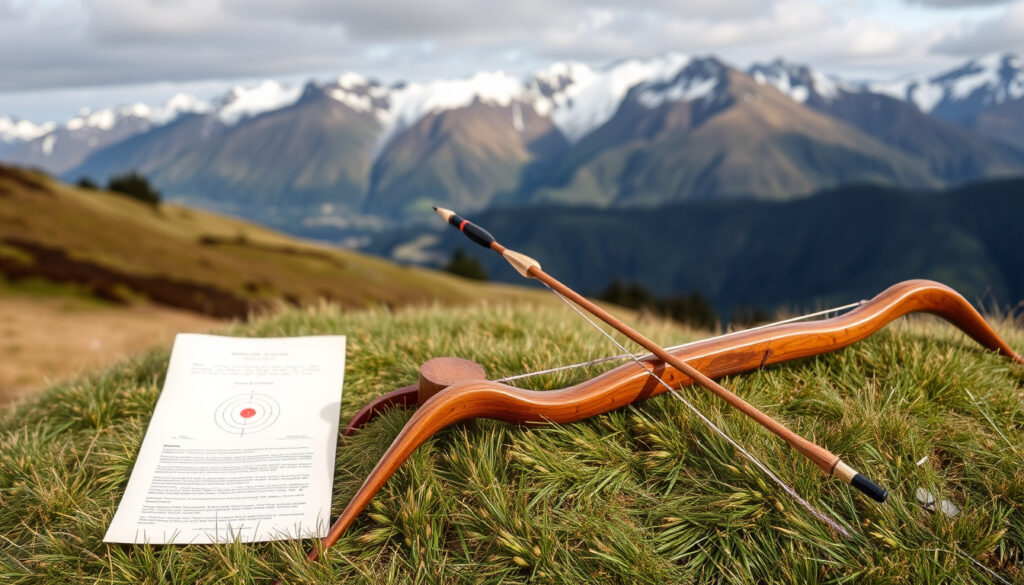
Bow and Arrow in NZ: Laws, History, and Buying Tips
If you’ve ever wondered whether you need a license to buy a bow and arrow in New Zealand, you’re not alone. The rules are simpler than most people expect — for bows, but not for crossbows — and they tie directly into the country’s unique hunting culture.
Minimum age to purchase a bow in NZ: 18 ·
License required to own a bow: No ·
Crossbow license required: Yes ·
Māori traditional use of bow and arrow: No ·
Popular bow type for hunting in NZ: Compound ·
Backyard archery legal with precautions: Yes
Quick snapshot
- No license needed to own a bow in NZ (New Zealand Police official FAQ)
- Exact number of active bow hunters in NZ — no central registry
- Bow hunting permits introduced by DOC for public conservation land — a modern framework
- Growing interest in recreational archery and bow hunting across NZ regions
The balance between freedom and regulation is the defining theme of New Zealand’s approach to archery equipment.
| Fact | Value |
|---|---|
| Minimum age for bow purchase | 18 |
| License required to own a bow | No |
| Crossbow permit required | Yes |
| Māori traditional weapon | Not bow |
| Backyard archery legal | Yes, with precautions |
| Popular bow type in NZ | Compound |
Do you need a license to own a bow in NZ?
What is the legal age to own a bow?
- You must be 18 years or older to purchase a bow in New Zealand. This age requirement is enforced by retailers like Hunting & Fishing and Gun City, who check ID before sale. (Hunting & Fishing NZ policy)
Do you need a firearms license for a bow?
- No. A standard bow — compound, recurve, or longbow — does not require a firearms license under the Arms Act 1983. The New Zealand Police official firearms safety guidance confirms this distinction.
Are there any restrictions on bow ownership in NZ?
- There are no specific restrictions on owning a bow, but police advise that bows should only be carried with a lawful, proper, and sufficient purpose — for example, archery practice or hunting. (New Zealand Police FAQ)
For most buyers, the ownership process is simpler than buying a can of spray paint (which requires ID for age-restricted sales). No paperwork, no registry, just a valid reason for carrying.
The implication: New Zealand treats bows as tools for sport and pest control, not weapons requiring state oversight. The freedom is refreshing — but it also places responsibility squarely on the buyer to use them safely.
Are crossbows legal in New Zealand?
What is the difference between a bow and a crossbow under NZ law?
- Crossbows are classified as offensive weapons under the Crimes Act 1961, not as firearms. This classification comes from New Zealand Police official legal guidance. Bows are not classified as weapons in the same way — they fall under general property law.
Do I need a license for a crossbow?
- No license is required to own a crossbow, but a permit from the Police is needed to possess one. The New Zealand Police Arms Act guidance states that without a permit, possession is illegal.
Can I hunt with a crossbow in NZ?
- Yes, crossbow hunting on public conservation land requires a hunting permit from the Department of Conservation (DOC). Crossbows must meet minimum specifications: a drawing weight factor of 68 kg (150 lb) and a positive mechanical safety device in working order. (Department of Conservation crossbow hunting rules)
Crossbow owners face a two-step approval process: a Police permit to possess, plus a DOC permit to hunt. Bows require neither. The crossbow’s higher power and mechanical nature place it under stricter oversight.
Why this matters: A crossbow’s legal path is more complex. If you’re considering a crossbow over a compound bow for hunting, factor in the extra paperwork — it can take weeks to process a Police permit.
Did the Māori use bows and arrows?
What weapons did Māori use?
- Māori primary weapons were hand-to-hand: spears (taiaha), clubs (patu), and staffs. The Te Ara – The Encyclopedia of New Zealand Māori weapons section notes that bows and arrows were not part of the traditional arsenal.
Why didn’t Māori adopt the bow as a primary weapon?
- New Zealand’s dense bush and close-quarters combat favoured short, sturdy weapons over projectile tools. The Te Ara Encyclopedia historical analysis explains that Māori warfare was built around fortifications (pā) and hand-to-hand fighting, where bows had limited effectiveness.
Are there any traditional Māori archery practices?
- No. Bow and arrow were introduced by European settlers in the 19th century. Modern archery culture in New Zealand emerged in the 20th century, independent of Māori tradition. (Te Ara – The Encyclopedia of New Zealand)
“Māori did not traditionally use bows and arrows. Their weapons were designed for close combat — spears, clubs, and staffs — which suited the New Zealand landscape and their military tactics.”
— Te Ara – The Encyclopedia of New Zealand, Weapons section
New Zealand has no indigenous archery tradition, yet it’s become a popular recreational pursuit. The bow arrived with Europeans and found a niche in a country that values outdoor sports and hunting.
The pattern: New Zealand’s archery culture is a modern import, not a revival. That means no historical baggage constraining new users — just a fresh start for anyone picking up a bow.
Can I use a bow and arrow in your backyard?
What are the legal restrictions on backyard archery in NZ?
- No specific national law bans backyard archery. However, the New Zealand Police legal guidance on weapons states that any use must be lawful and not endanger others. Council noise and nuisance bylaws may also apply.
What safety measures are recommended?
- DOC recommends a backstop (e.g., hay bales or a plywood target board) and a clear zone. Arrows must be non-barbed for hunting, but for backyard practice, standard target arrows are fine. (Department of Conservation safety guidance)
How to build a safe backyard archery range?
- Choose a space at least 20 metres from any property line or building.
- Install a backstop — a thick plywood board or stacked hay bales work well.
- Mark a clear shooting lane with no overhead branches or obstacles.
- Inform neighbours if you plan regular practice to avoid complaints under local noise bylaws.
The trade-off: You can legally shoot in your backyard, but you’re self-regulating. If an arrow strays onto a neighbour’s property, you could face liability under the Crimes Act for reckless endangerment. A well-designed range eliminates that risk.
What are the best bows and arrows to buy in New Zealand?
What types of bows are available in NZ?
- Three main types: compound bows (most popular for hunting), recurve bows (common for target archery), and longbows (traditional design). The Department of Conservation hunting guidance recommends compound bows for their power and accuracy in hunting scenarios.
Which brands are popular in New Zealand?
- Top brands include Hoyt, PSE, Bear, and Samick. These are stocked by major retailers. (Archery Warehouse NZ brand listings)
What is the best bow for beginners?
- An entry-level recurve bow (around $150–$300) or a budget compound bow (starting at $400) suits beginners. The Hunting & Fishing NZ buying advice suggests starting with a lower draw weight (20–35 lb for recurve, 30–50 lb for compound) to build technique.
Where to buy bows and arrows in NZ?
- Three main retailers: Hunting & Fishing (nationwide), Gun City (multiple stores), and Archery Warehouse (online specialist). Online options include Trade Me and Amazon Australia (check shipping costs). (Archery Warehouse NZ)
“For hunting on public conservation land, your bow must have a minimum drawing weight of 15 kg (35 lb). Arrows must be non-barbed, with a minimum blade diameter of 22 mm (7/8 in).”
— Department of Conservation, Bow hunting regulations
“Our advice for first-time buyers: invest in a quality backstop and a good target before upgrading your bow. Safety gear — arm guard, finger tab, and a bow case — adds only $60–$100 to the total.”
— Archery Warehouse NZ, customer guide
What this means: The DOC hunting specs set a baseline for any bow used for hunting. If you’re buying for target practice only, you have more flexibility on draw weight and arrow type. For beginners, the cheapest safe option is a recurve kit under $200 — but expect to upgrade within a year if you get serious.
Related reading: Google News New Zealand · New Zealand Strong Winds & Rain: Records and Safety
nzhuntingandshooting.co.nz, nzbowhunters.nz, nzhuntingandshooting.co.nz, govt.nz, nzbowhunters.nz, nzgameanimalcouncil.org.nz, archery.org.nz, doc.govt.nz, mountainsafety.org.nz, alpinehunting.com
Frequently asked questions
How do I get a crossbow permit in NZ?
Apply to the New Zealand Police under the Arms Act 1983. You’ll need to provide a lawful purpose — target shooting or hunting — and undergo a background check. Processing can take several weeks. (New Zealand Police crossbow FAQ)
What is the best compound bow for hunting in NZ?
The Hoyt Torrex, PSE Stinger, and Bear Cruzer are top choices among NZ hunters. All meet the DOC minimum draw weight of 35 lb. Price range: $600–$1,200. (Archery Warehouse NZ)
Is bow and arrow legal for hunting game in NZ?
Yes, bow hunting is legal on public conservation land with a DOC permit, provided your bow meets the minimum draw weight of 35 lb and arrows are non-barbed. (DOC bow hunting rules)
Can I buy a bow online in NZ?
Yes, online retailers like Archery Warehouse and Trade Me sell bows. You must be 18 or older to purchase, and ID checks apply at physical pickup or delivery. (Archery Warehouse NZ)
What safety gear do I need for archery?
An arm guard, finger tab or release aid, and a bow case are recommended. A quality backstop is essential for backyard practice. Budget $60–$100 for the basics. (Archery Warehouse NZ customer guide)
Are there archery clubs in NZ?
Yes, archery clubs operate across New Zealand, offering coaching, range access, and competitions. Search online for clubs in your region.
Do I need to register my bow in NZ?
No. Bows are not registered in New Zealand. Only crossbows require a Police permit, not a registration. (New Zealand Police FAQ)
What is the penalty for illegal bow use in NZ?
Using a bow in a manner that endangers others may result in charges under the Crimes Act for reckless endangerment. Carrying a bow without lawful purpose can lead to confiscation. (New Zealand Police guidance)
More related posts
 Castlepoint Hotel License Issues: Closure and Backlash
 Emerald Cut Engagement Rings: Costs, Pros & Buying Guide
 A Nightmare on Elm Street: Facts and Banned Sequel
 Mobile Mechanic Near Me: Costs & Guide (Ireland 2026)
 Book Driving Test NZ – Step-by-Step Guide for Restricted and Full
 Baltimore Ravens vs Bengals Match Player Stats – 2024 Box Scores & Leaders
 Cashier’s Check: Definition, How to Get One, and Risks Explained
 Bed Bath & Beyond: What happened, new name, and how to order