Te Whānau-ā-Apanui: History, Culture & Settlement
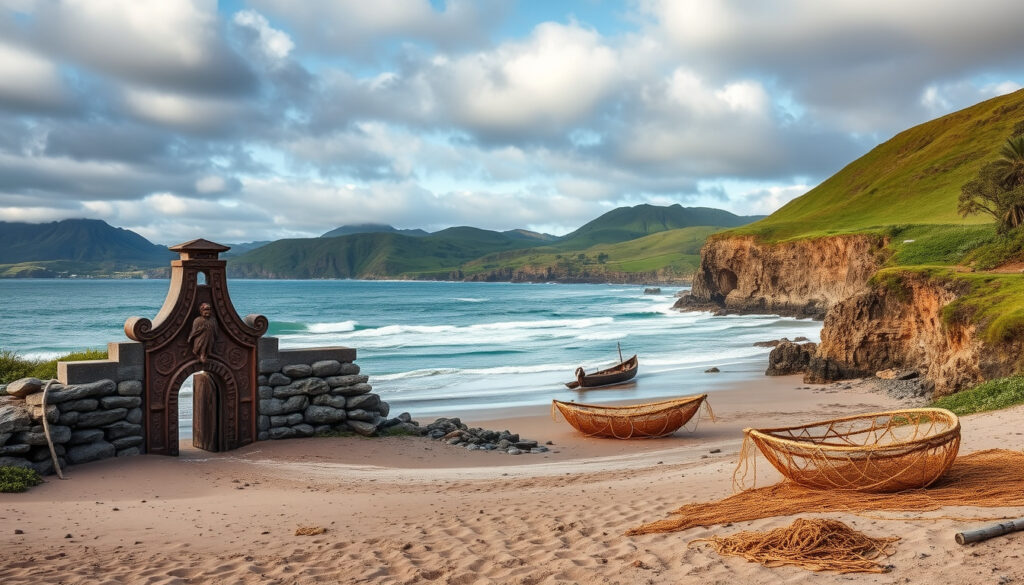
There’s something about the stretch of coastline from Cape Runaway to Opotiki that feels both wild and cared for. It’s the rohe of Te Whānau-ā-Apanui, an iwi whose identity is woven into the sea, the land, and an active volcano.
Affiliated population (2018 census): 14,430 · Tribal territory length: Approximately 100 km of coastline from Te Taumata-ō-Apanui to Pōtaka · Number of marae: 6 major marae · Notable landmark: Whakaari (White Island) – active volcano held as a taonga · Deed of Settlement year: 2023
Quick snapshot
- Te Whānau-ā-Apanui is a recognised Māori iwi with a rohe from Te Taumata-ō-Apanui to Pōtaka (Te Ara – Encyclopedia of New Zealand)
- Population 14,430 according to the 2018 census (Wikipedia (citing Stats NZ))
- Deed of Settlement signed in 2023, including a Crown apology and redress (Te Tari Whakatau (Treaty Settlements office))
- Whakaari (White Island) is within the rohe and the iwi act as kaitiaki (guardians) (Te Ara – Encyclopedia of New Zealand)
- The exact meaning of “Apanui” is debated among historians — some interpret “apa” as “path” or “line”, others as “to carry” (Te Ara (notes varied interpretations))
- The number of hapū within the iwi varies in different historical sources (Te Ara (notes varied interpretations))
- The 2023 Deed of Settlement marks a turning point — the first full settlement for the iwi after decades of negotiation (Te Tari Whakatau)
- The iwi is set to use settlement assets to boost economic resilience while maintaining kaitiakitanga over the coast and Whakaari (New Zealand Government (Beehive))
Seven key facts paint a clear picture of the iwi’s size, governance, and cultural anchors.
| Label | Value |
|---|---|
| Official Name | Te Whānau-ā-Apanui |
| Rohe (Tribal Territory) | Te Taumata-ō-Apanui to Pōtaka |
| Total Affiliated (2018 Census) | 14,430 |
| Number of Marae | 6+ major marae |
| Deed of Settlement Status | Finalised 2023 |
| Statutory Representative Body | Te Rūnanga o Te Whānau |
| Notable Ancestor | Apanui |
What is Te Whānau-ā-Apanui?
Te Whānau-ā-Apanui is a Māori iwi (tribe) whose rohe (tribal territory) runs along the eastern Bay of Plenty and East Coast — a rugged strip of coastline stretching from Te Taumata-ō-Apanui (near Cape Runaway) south to Pōtaka (near Opotiki). The name itself means “the family of Apanui,” and the iwi is composed of several hapū (sub-tribes) that all trace descent from the founding ancestor Apanui Ringamutu (Te Ara – the Encyclopedia of New Zealand (national reference)).
As of the 2018 census, 14,430 people affiliate with Te Whānau-ā-Apanui, making it one of the medium-sized iwi by population in New Zealand (Wikipedia (citing Stats NZ data)).
Is Te Whānau-ā-Apanui a iwi?
Yes — Te Whānau-ā-Apanui is formally recognised as an iwi under New Zealand law. The iwi’s statutory representative body is Te Rūnanga o Te Whānau, which manages settlement assets and represents the iwi in treaty negotiations and resource management (Te Tari Whakatau (Treaty Settlements office)).
Apanui’s mother Rongomaihuatahi was descended from Porourangi of the Horouta canoe, linking Te Whānau-ā-Apanui’s genealogy to a wider East Coast iwi network. That whakapapa underpins the iwi’s mana and its place in Māori history (Te Ara).
The pattern: The iwi is both a political entity and an extended family network. Its formal recognition and settlement infrastructure are modern tools to protect an ancient identity.
What does Apanui mean in Māori?
The name “Apanui” is a personal name — the iwi is named after the ancestor Apanui Ringamutu. Linguists break the name into “apa” (which can mean a line, a path, or to carry) and “nui” (big, great). The exact sense is debated: some suggest “great line” (referring to a lineage), others “great carrier” (a metaphorical role). Te Ara notes that interpretations vary among historians (Te Ara – the Encyclopedia of New Zealand).
So “Te Whānau-ā-Apanui” literally translates as “the family of Apanui.” The “ā” particle indicates possession, making the meaning: “the descendants (whānau) of (ā) Apanui.”
Because no single written record from Apanui’s time exists, the precise etymology remains open. That ambiguity hasn’t weakened the iwi’s identity — if anything, the oral tradition allows each generation to bring its own understanding.
What this means: While the name’s exact root is uncertain, its function is clear — it binds a community to a shared ancestor and a territory.
What is the connection of Te Whānau-ā-Apanui to the sea?
The relationship is total. The iwi’s rohe is entirely coastal — about 100 km of shoreline — and the sea provides physical food (fish, shellfish, seaweed) and spiritual identity. Te Ara states that the iwi has strong traditions of fishing, gathering, and navigation (Te Ara – the Encyclopedia of New Zealand).
Most importantly, Whakaari (White Island) — New Zealand’s most active volcano — sits within the iwi’s rohe. Te Whānau-ā-Apanui are kaitiaki (guardians) of the island and its surrounding waters. This role was tested in 2019 when the volcano erupted, killing 22 people. The iwi responded by reinforcing its call for greater control over access and safety, arguing that their kaitiakitanga included the duty to protect both the land and visitors.
- The iwi’s creation stories often involve the ocean — ancestors arrived on the Horouta waka (Te Ara).
- European whalers taught local people to hunt whales in the 1820s–1830s, and whaling became a major industry for the iwi in the early 20th century (Te Ara).
- Today, fishing remains central to the rural economy along the coast.
The implication: For this iwi, environmental stewardship (kaitiakitanga) isn’t a modern policy choice — it’s a direct expression of ancestry.
Where is Te Whānau-ā-Apanui located?
The rohe occupies a compact strip of the East Coast from Te Taumata-ō-Apanui (near Cape Runaway) south to Pōtaka (a few kilometres east of Opotiki). Major settlements along the coastline include Raukokore, Torere, and Ōhiwa (Te Ara – the Encyclopedia of New Zealand).
- Raukokore – home to Raukokore Marae
- Torere – Torere Marae
- Ōhiwa – Ōhiwa Marae
- Other marae include Ōmāio, Ōtama, and Ōtūwhare
What are the marae of Te Whānau-ā-Apanui?
The iwi has six major marae, each serving as a hub for community gatherings, ceremonies, and education. Marae are not just buildings — they are the physical expression of the iwi’s identity and mana. Visitors are generally welcome but should contact the marae or Te Rūnanga o Te Whānau beforehand.
Why this matters: The marae are the beating heart of iwi life. Their locations along the coast reinforce how geography shapes community — each marae is within walking distance of the sea.
What is Te Whānau-ā-Apanui known for?
Te Whānau-ā-Apanui is known first for its maritime identity and guardianship of Whakaari. The iwi’s kaitiakitanga over the volcano and surrounding waters has national visibility, especially since the 2019 eruption. But the iwi is also recognised for:
- Whaling history – in the 1820s–1830s local people learned whaling from European whalers, and by the early 1900s whaling was a major industry (Te Ara).
- Agricultural transition – in the 1900s land was cleared for cattle, sheep, and dairy farms. Small farms boomed then struggled in the 1980s (Te Ara).
- Contemporary arts – carving, weaving, and visual arts thrive, with many artists exhibiting nationally.
- Treaty settlement – the 2023 Deed of Settlement is the largest single event in the iwi’s modern history, including a Crown apology and a redress package of around $30 million in financial and commercial assets, plus cultural redress and land returns (New Zealand Government (Beehive)).
What is the Te Whānau a Apanui deed of settlement?
The Deed of Settlement is the final settlement of all historical Treaty of Waitangi claims of Te Whānau a Apanui arising from Crown acts before 21 September 1992 (Te Tari Whakatau (Treaty Settlements office)). The package includes:
- A statement on sovereignty (the iwi maintain they never ceded sovereignty)
- An agreed historical account
- Crown acknowledgements and a formal apology
- Bespoke natural resource and conservation arrangements (including co-management of Whakaari)
- Vesting of twelve sites of significance, two Crown properties, a right to purchase one further property, and rights of first refusal over Crown land
The trade-off: The settlement resolves long-standing grievances but also requires the iwi to work within the Crown’s legal framework. The sovereignty statement is symbolic — it asserts mana while operating under Crown law.
What is the history of Te Whānau-ā-Apanui?
The history spans several centuries, from pre-contact settlement to 21st-century settlement. Here’s a timeline of key events. To understand the history of Te Whānau-ā-Apanui, you can explore Woolworths mailer this week.
- Pre‑1800s: Descendants of Apanui settle along the eastern Bay of Plenty coast; oral traditions record whakapapa and land occupation. (Te Ara)
- 1820s–1830s: Musket Wars; Te Whānau-ā-Apanui participates in inter‑tribal conflicts. European whalers arrive and teach whaling (Te Ara).
- 1840s: Signing of the Treaty of Waitangi; iwi members sign at various locations. (Te Ara)
- 1864–1865: Conflict during the New Zealand Wars; land confiscations follow. (Te Ara)
- 1920s–1940s: Land consolidation and urban migration; traditional economy declines. (Te Ara)
- 1980s–1990s: Formation of Te Rūnanga o Te Whānau; start of Treaty settlement process. (Te Ara)
- 2020: Te Whānau a Apanui initialled Deed of Settlement with the Crown (New Zealand Government (Beehive)).
- 2023: Deed of Settlement formally signed, including a Crown apology and redress package (
The pattern: The iwi’s history is a series of shocks — musket wars, land war, confiscation, urbanisation — followed by periods of adaptation. The 2023 settlement is the latest adaptation, this time on the iwi’s own terms.
Clarity: What we know and what remains uncertain
Based on available sources, here is a summary of confirmed facts and areas where historical detail is less clear.
Confirmed facts
- Te Whānau-ā-Apanui is a recognised iwi with a defined rohe along the East Cape (Te Ara).
- The iwi has a Deed of Settlement effective 2023 (Te Tari Whakatau).
- Population figure of 14,430 from 2018 Census (Wikipedia citing Stats NZ).
- Whakaari (White Island) is within the iwi’s rohe and holds cultural significance (Te Ara).
- Whaling was a major early‑20th‑century industry (Te Ara).
What’s unclear
- The exact origin and meaning of the name “Apanui” is debated among historians (Te Ara).
- The number of hapū within the iwi varies in different historical sources.
- The pre-colonial population of Te Whānau-ā-Apanui is not recorded in written sources.
- The exact date of the signing of the Treaty of Waitangi by iwi members is not precisely documented.
- The total area of the rohe is not precisely defined in terms of square kilometers.
Quotes from key sources
“Te Whānau-ā-Apanui’s tribal territory is a strip of the East Coast from Te Taumata-ō-Apanui to Pōtaka. Whakaari (White Island) and Mount Whanokao are significant places.”
T.D. Marshall, Te Ara – the Encyclopedia of New Zealand (definition of iwi and rohe boundaries)
“The Deed of Settlement includes a statement on sovereignty, an agreed historical account, Crown acknowledgements and apology, bespoke natural resource and conservation arrangements, and land return provisions.”
Te Tari Whakatau (Treaty Settlements office) – summary of settlement contents
“The Agreement in Principle outlines a $30 million financial and commercial redress package, along with a unique cultural redress package.”
New Zealand Government (Beehive) – announcement of Agreement in Principle
“In 2013 almost 13,000 people said they were affiliated to Te Whānau-ā-Apanui.”
Stats NZ commentary via Te Ara – demographic trends
The takeaway: The sources align on the iwi’s territory, settlement details, and demographic scale. The only friction is over the name’s meaning — a minor note in an otherwise well-documented story.
Summary: A community anchored in the sea
Te Whānau-ā-Apanui has spent two centuries navigating change — from whaling and farming to urban drift and Treaty negotiation. The 2023 settlement gives the iwi a platform to revive its economic base while continuing its ancestral role as kaitiaki of the eastern Bay of Plenty coast. For a community of 14,430 people spread along a hundred kilometres of shoreline, the choice is clear: hold the sea as close as ever, or watch the tide slip away.
Frequently asked questions
What is the Te Whānau a Apanui pepeha?
The pepeha is a tribal saying that connects the iwi to its canoe (Horouta), its mountain (Whanokao), its river (often the Mōtū or Ōtara), and its sea (the Bay of Plenty). Exact wording varies by hapū and marae.
How do I register with Te Whānau-ā-Apanui?
Registration is handled through Te Rūnanga o Te Whānau. You will need to provide whakapapa (genealogy) linking to a recognised ancestor. Contact the Rūnanga via its official website or one of the marae.
What is the official website of Te Whānau-ā-Apanui?
The statutory body Te Rūnanga o Te Whānau maintains an official site. As of this writing, the domain is not widely indexed, but the iwi is active on Facebook under “Te Whānau a Apanui” and through the Treaty settlement portal at whakatau.govt.nz.
Can visitors visit the marae of Te Whānau-ā-Apanui?
Yes, but visitors should arrange visits in advance through the marae committee or Te Rūnanga. Marae are living communities, not tourist attractions. Cultural protocols (tikanga) apply, so always seek guidance.
What does the Te Whānau a Apanui deed of settlement include?
It includes a sovereign statement, historical account, Crown apology, $30 million financial redress, cultural redress (including co-management of Whakaari), vesting of 12 sites of significance, two Crown properties, a right to purchase one property, and rights of first refusal over Crown land (Te Tari Whakatau).
What is the relationship between Te Whānau-ā-Apanui and Whakaari (White Island)?
Whakaari is within the iwi’s rohe and is a taonga (treasure). The iwi are kaitiaki (guardians) of the island and its surrounding waters. After the 2019 eruption, the iwi called for greater control over access and safety measures (Te Ara).
Are there any notable people from Te Whānau-ā-Apanui?
Yes. Notable figures include Sir Peter Buck (Te Rangi Hīroa) – though primarily of Ngāti Mutunga, he had Apanui connections; and visual artists like Fred Graham (sculptor) and painter Robyn Kahukiwa have whakapapa ties. Many contemporary leaders in Māori education and conservation also affiliate with the iwi.
More related posts
 House and Land Packages Christchurch: 2025 Guide & Prices
 Kiwis vs Samoa 2025 Time: Final Result & Kickoff Details
 Bonnie Blue Net Worth 2025: How Much She Really Earns on OnlyFans
 185 Pounds in kg: Conversion, BMI, and Health Implications
 Copper Price Per Pound: Current Rate & Scrap Value Guide
 Stuff Sports News Today: Latest Updates & Global Rankings
 Prince Harry Latest News: Melbourne Visit, Australia Trip
 Payroll Software for Restaurants: Best Picks & Guide