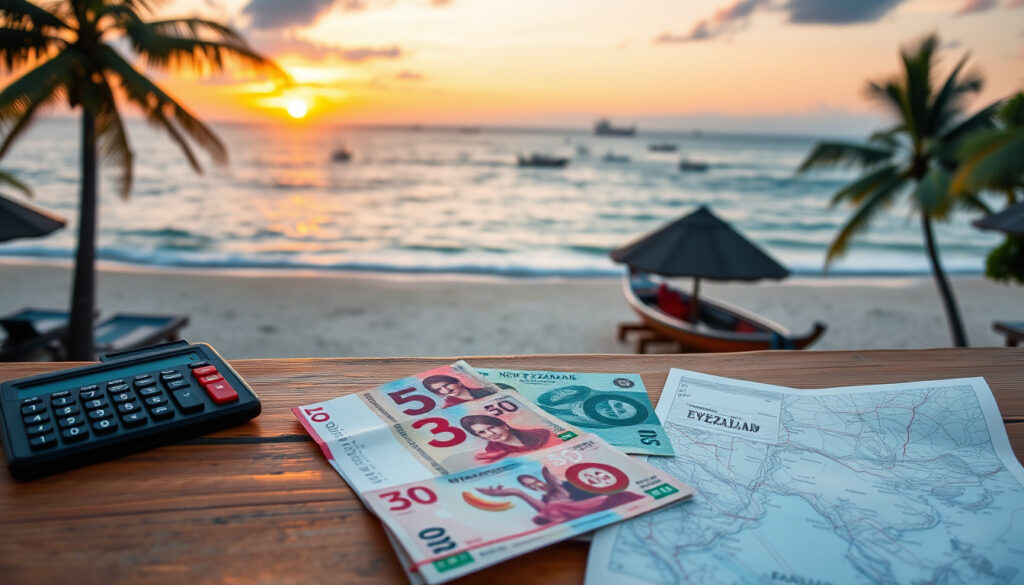
Bali Currency to NZD: Exchange Rate & Travel Money Guide 2025
You’ve booked the flights, packed the sunscreen, and now you’re staring at the exchange rate wondering how far your New Zealand dollars will stretch in Bali. Whether you’re a backpacker budgeting for warung meals or a mid-range traveler eyeing a villa, knowing the real cost in Indonesian rupiah makes all the difference. This guide walks through the current NZD to IDR rate, daily spending for different travel styles, and the smartest ways to get your money there.
Current exchange rate (1 NZD to IDR): 10,204 IDR ·
Average daily budget (backpacker): $40–60 NZD ·
Average budget (mid-range traveler): $80–150 NZD ·
Typical cost of a local meal: 50,000 IDR (~$4.80 NZD) ·
Average mid-range hotel per night: 500,000 IDR (~$48 NZD) ·
Typical cost of a 5-day trip (mid-range): $400–750 NZD
Quick snapshot
- Bali uses Indonesian rupiah (IDR) as official currency (Bank Indonesia)
- Mid-market rate: 1 NZD ≈ 10,204 IDR (Xe)
- ATMs widely available in tourist areas (Lonely Planet)
- Credit cards accepted at larger hotels and restaurants (BCA)
- Future exchange rate trends (forecast uncertain)
- Exact fees at specific ATMs or exchange booths vary
- Impact of local regulations on foreign exchange transactions
- Rates fluctuate daily; forex markets closed on weekends (OFX)
Six key facts about Bali currency for Kiwi travelers, one pattern: the mid-market rate gives a baseline, but the real cost depends on fees and spreads.
| Label | Value |
|---|---|
| Current rate (1 NZD to IDR) | 10,204 IDR (mid-market) |
| Average local meal cost | 50,000 IDR ($4.80 NZD) |
| Average mid-range hotel night | 500,000 IDR ($48 NZD) |
| Typical 5-day budget (mid-range) | $400–750 NZD |
| Withdrawal ATM fee (Bali) | 40,000–50,000 IDR (~$4–5 NZD) per transaction |
| Exchange bureau spread | 3–8% above mid-market |
How much is 1 NZD to Indonesian rupiah?
At mid-market rates, 1 New Zealand dollar buys roughly 10,200 Indonesian rupiah. That figure comes from the global forex market where currencies trade in real time. Xe (currency converter) recorded 1 NZD = 10,210.67 IDR in one snapshot, while Wise (comparison tool) showed 10,236.3 IDR on another — small differences that reflect the minute-by-minute market moves.
What is the current mid-market exchange rate?
- Mid-market rate: 1 NZD ≈ 10,204 IDR (Xe)
- Reciprocal: 1 IDR ≈ 0.000098 NZD (Xe)
- Bank Indonesia (central bank) publishes a reference rate (JISDOR) for USD/IDR, which banks use to set their own NZD/IDR quotes
The mid-market rate is the midpoint between buy and sell prices, explained by Xe. What you actually get at a bank or exchange booth will be a few percent worse because they add a margin.
How often does the exchange rate change?
- Forex markets trade 24/5; rates update constantly during the week
- OFX (money transfer service) notes that exchange rates are unavailable on weekends because markets close
- Historical data: Travelex NZ (currency exchange) provides up to 12 months of NZD/IDR history
The pattern: if you check a rate on Friday night and exchange on Monday morning, the number can shift. Lock in a rate when you buy cash or use a transfer service that holds the rate for a few hours.
Is it better to exchange NZD in NZ or Indonesia?
New Zealanders have three main options: exchange cash before departure, use ATMs in Bali, or rely on travel cards. Each method carries different fees and exchange margins.
What are the fees for exchanging in New Zealand?
- TravelMoney NZ (currency retailer) sells Indonesian rupiah online or in-store; rates include a spread but offer guaranteed stock
- Travelex NZ (exchange service) provides real-time rates for NZ customers
- Bank branches in NZ typically charge a commission or apply a wider spread than specialists
What are the fees in Bali?
- ATMs in Bali dispense IDR at competitive mid-market rates but charge a flat fee of 40,000–50,000 IDR per withdrawal (~$4–5 NZD) according to BCA (major Indonesian bank)
- Exchange booths in tourist areas (Kuta, Seminyak) often advertise “no commission” but use spreads of 3–8% above mid-market
- Bank Indonesia publishes official rates – these are closer to mid-market than booth rates
Should I use ATMs, exchange bureaus, or banks?
- ATMs: best for convenience, but watch for daily withdrawal limits and fees
- Exchange bureaus: worst rates, best avoided unless you need small cash urgently
- Travel cards (Wise, Revolut): load NZD and convert at mid-market with low fees; Revolut (multi-currency app) supports NZD to IDR conversion
- Major Indonesian banks like BCA offer on-site exchange for foreign notes
The trade-off: exchanging in NZ gives certainty but lower value. Using ATMs or travel cards in Bali gives better rates but requires planning. Most savvy Kiwis carry a small amount of rupiah for arrival and use a travel card (Wise, Revolut) for the rest.
A traveler who withdraws 2,000,000 IDR from a Bali ATM pays about 50,000 IDR in fees – roughly 2.5% on top of the mid-market rate. Exchanging the same amount at a tourist booth could cost 5–8% in spread. The ATM wins.
How much NZD per day in Bali?
Daily spending in Bali varies dramatically with accommodation and dining choices. The table below breaks down typical costs for two common traveler profiles.
| Item | Backpacker | Mid-range |
|---|---|---|
| Accommodation | Hostel/guesthouse $15–25 NZD | 3-star hotel/villa $40–80 NZD |
| Food | Local warung meals $4–7 NZD | Restaurants/cafés $15–30 NZD |
| Transport | Scooter rental or bemo $5–10 NZD | Private driver/taxi $20–40 NZD |
| Activities | Free beaches, temples $1–3 | Spa, tours, water sports $20–50 NZD |
| Total daily | $40–60 NZD | $80–150 NZD |
Typical costs: a local meal at a warung costs 50,000 IDR (~$4.80 NZD), while a mid-range restaurant meal is about 150,000 IDR (~$14 NZD). Scooter rental runs 70,000 IDR per day (~$6.70 NZD), a short taxi trip around 50,000 IDR (~$4.80 NZD).
The pattern: accommodation is the biggest variable. Backpackers can keep daily costs under $50 NZD by staying in hostels and eating local, while mid-range travelers spending $100+ NZD get more comfort but pay for it.
How much to bring to Bali for 5 days?
Planning your total Bali budget in NZD depends on your travel style and whether you prepay accommodation. Here’s a sample 5-day breakdown for two scenarios.
| Category | Backpacker (5 days) | Mid-range (5 days) |
|---|---|---|
| Accommodation | $75–125 NZD | $200–400 NZD |
| Food & drinks | $50–80 NZD | $100–200 NZD |
| Transport | $25–50 NZD | $50–100 NZD |
| Activities & extras | $50–75 NZD | $80–150 NZD |
| Contingency (10%) | $20–35 NZD | $45–85 NZD |
| Total | $200–300 NZD | $400–750 NZD |
Carry a mix of cash and card. ATMs are widely available in tourist areas, but exchange at hotels and airports offers the worst rates. A MoneyHub NZ (personal finance guide) recommends using a travel card with no foreign transaction fees to minimize costs.
“ATMs in Bali are the most convenient option for most travelers, but be aware of local withdrawal fees and your home bank’s international charges.”
“The mid-market rate gives a fair baseline, but what you actually pay depends on the provider’s spread and any fees added.”
Xe (currency authority)
“Exchange rates are unavailable on weekends because forex markets are closed, so plan your conversions during the business week.”
Is $100 a lot of money in Indonesia?
$100 NZD converts to roughly 1,020,000 IDR at current rates. That sum covers a backpacker for 3–5 days of meals, or pays for a mid-range hotel for 2–3 nights. It also funds a day trip including lunch, a scooter rental, and entrance to a temple or waterfall.
Indonesia’s cost of living is significantly lower than New Zealand’s. Statista (data research firm) reports that consumer prices in Indonesia are roughly 60% lower than in New Zealand for everyday items. A $100 NZD note stretches further in Bali than at home – but luxury resorts and Western dining can quickly burn through it.
- $100 NZD ≈ 1,020,000 IDR
- Covers 3–5 days of meals for one person
- Pays for a mid-range hotel for 2–3 nights
- Funds a day trip with lunch, transport, and entrance fees
- Cost of living in Indonesia is about 60% lower than in New Zealand (Statista)
While $100 NZD has real purchasing power in Indonesia, most Kiwis end up spending more because Bali’s tourist economy charges premium prices for comfort items like Western food, cocktails, and air-conditioned taxis.
Exchange method comparison
Three common ways to get rupiah, one pattern: the best value goes to travelers who avoid tourist booths and use a combination of ATMs and travel cards.
| Method | Rate quality | Fees | Convenience | Best for |
|---|---|---|---|---|
| Travel card (Wise, Revolut) | Mid-market + small fee | Low (1% or less) | High – use at ATMs and POS | Main spending |
| ATM withdrawal in Bali | Mid-market + local fee | 40,000–50,000 IDR per withdrawal | Moderate – find a bank ATM | Cash top-ups |
| Exchange booth in Bali | 3–8% spread | Often hidden in rate | Low – but risk of scams | Emergency cash only |
| Cash exchange in NZ | 2–5% spread | Commission or spread | High – do it before leaving | A small starter amount |
The implication: For a mid-range 5-day trip ($500–750 NZD), using a travel card instead of exchange booths can save $25–60 NZD in fees and poor rates. That’s two nice dinners.
Upsides
- Travel cards give near mid-market rates with low fees
- ATMs widely available in tourist areas
- Credit cards accepted at hotels and larger restaurants
- No need to carry large amounts of cash
Downsides
- Exchange booths often have poor rates and scams
- ATM fees add up if you make many small withdrawals
- Some smaller businesses charge 3% fee for card payments
- Weekend rates may be stale if you exchange on Monday
Steps to plan your Bali money
Follow these practical steps to get the best value from your New Zealand dollars in Bali.
- Check the current mid-market rate on Xe or Wise a few days before travel.
- Set up a travel card like Wise or Revolut, load NZD, and convert at mid-market rates.
- Order a small amount of IDR cash from TravelMoney NZ or Travelex NZ for arrival expenses (enough for taxi and first meal, about $50–100 NZD).
- Enable international withdrawals on your debit card and check fees with your NZ bank.
- Use ATMs belonging to major banks (BCA, Mandiri) inside convenience stores or bank branches – avoid standalone machines with high fees.
- Withdraw larger amounts less often to minimize per-transaction ATM fees (e.g., take out 2,000,000 IDR at once).
- Keep some cash for small purchases – warungs, street food, and entrance fees often don’t accept cards.
- Decline dynamic currency conversion at ATMs and POS terminals – always choose IDR, not NZD, to avoid a punitive exchange rate.
Clarity: What’s confirmed and what’s still uncertain
Confirmed facts
- Exchange rates fluctuate daily and are set by global forex markets (OFX)
- Bali uses Indonesian rupiah (IDR) as official currency (Bank Indonesia)
- ATMs are widely available in tourist areas (Lonely Planet)
- Credit cards accepted at larger hotels, restaurants, and shops
What’s unclear
- Future exchange rate trends (forecast uncertain)
- Exact fees at specific ATMs or exchange booths may vary
- Impact of local regulations on foreign exchange transactions
“Bank Indonesia provides official foreign exchange transaction rates and a reference rate for non-USD/IDR calculations.”
Bank Indonesia (central bank regulator)
“Travelex NZ offers NZD to IDR exchange-rate charts and historical rates for up to 12 months, helping travelers track trends.”
Travelex NZ (currency retailer)
For the Kiwi traveler heading to Bali, the smartest approach is clear: skip the exchange booth, get a travel card before you leave, and use ATMs from major Indonesian banks for top-ups. The savings from avoiding poor rates and fees easily pays for a few extra nights in Ubud. Check your rate on Xe or Wise the morning you fly – and enjoy your bintang knowing your money is working as hard as you are.
For a similar breakdown of costs in another Pacific destination, check out our Fiji travel money guide for practical advice on exchanging currency and managing fees.
Frequently asked questions
What is the best currency to take to Bali?
Take Indonesian rupiah (IDR). New Zealand dollars are not accepted anywhere in Bali. Carry a small amount of IDR cash for arrival and use a travel card or ATM for the rest.
Should I use credit cards in Bali?
Yes, at larger hotels, restaurants, and shops. However, smaller warungs, markets, and transport often require cash. Some merchants add a 3% surcharge for card payments – always ask first.
Are there ATMs in Bali?
ATMs are widely available in tourist areas like Kuta, Seminyak, Ubud, and Sanur. Use ATMs inside major bank branches (BCA, Mandiri, BNI) to avoid skimmers and lower fees.
Can I use New Zealand dollars in Bali?
No. Bali only accepts Indonesian rupiah. Some exchange booths may accept NZD but will give poor rates. Always convert to IDR before spending.
Is it safe to carry cash in Bali?
Carrying small amounts for daily expenses is fine, but avoid flashing large sums. Use a money belt or hotel safe for larger amounts. ATMs are safer for getting cash as you go.
How do I calculate IDR to NZD in my head?
Divide the IDR amount by 10,000 to get a rough NZD figure (since 1 NZD ≈ 10,000 IDR). For exact conversions, use a converter app like Xe or Wise.
What is the best travel card for Bali?
Wise and Revolut both offer multi-currency accounts with mid-market rates and low fees. Wise charges about 0.5% on conversions, Revolut has a free tier with monthly limits. Both can be used at ATMs and for card payments.
Do I need to tip in Bali?
Tipping is not mandatory but appreciated. In restaurants, a 5–10% service charge is often included; if not, rounding up is common. For guides and drivers, 50,000–100,000 IDR per day is generous.
More related posts
 Night Agent Season 3: Release Date, Cast, Rose Status
 Black Snow (TV Series)—Cast, Seasons, Where to Watch
 Bed Bath & Beyond: What happened, new name, and how to order
 International Rugby Results Today: Scores, Fixtures & Man of the Match
 What Is Heavy Cream? Definition, UK Name, Substitutes & Uses
 Westpac NZ SWIFT Code WPACNZ2WXXX – Transfer Guide
 Houses for Rent Masterton – 2025 Prices and Availability