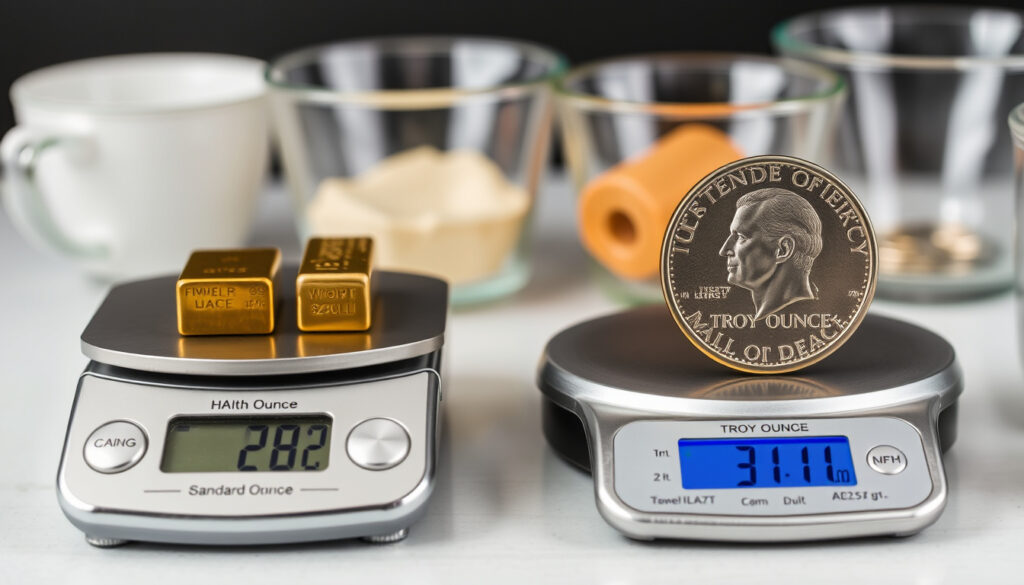
How Many Grams in an Ounce? Standard vs Troy Ounce Conversion
You’ve probably asked yourself at some point: exactly how many grams are in an ounce? The answer depends on whether you’re measuring flour for a recipe or weighing gold for an investment — and getting them mixed up could cost you.
Standard ounce to grams: 1 oz = 28.3495 g ·
Troy ounce to grams: 1 troy oz = 31.1035 g ·
Gold weight conversion: 1 troy oz = 31.1035 g ·
Rounded common conversion: 1 oz ≈ 28 g ·
Ounces in a pound: 16 oz = 453.592 g
Quick snapshot
- One standard ounce = 28.3495 g (Brite conversion tool)
- One troy ounce = 31.1035 g (The Royal Mint official site)
- 16 ounces = 1 pound = 453.592 g (Brite conversion tool)
- The exact origin of the troy ounce name is uncertain (Wikipedia on troy weight)
- When the troy system was first used for gold is not precisely documented (Wikipedia on troy weight)
- The standard ounce has been defined as 28.349523125 g since the international yard and pound agreement of 1959 (Brite reference)
- Expect more everyday kitchen scales to include both standard and troy settings as precious-metal investing grows
The table below summarizes the essential conversion values.
| Measurement | Exact value (grams) |
|---|---|
| Standard ounce | 28.3495 |
| Troy ounce | 31.1035 |
| Ounces in a pound | 16 |
| Grams in a pound | 453.592 |
| Typical cooking rounding | 28 g |
How many grams are in an ounce?
The simple answer: one standard avoirdupois ounce equals exactly 28.349523125 grams, as defined by the Brite conversion reference. For everyday cooking and baking, most recipes round this to 28.35 grams per ounce, which is precise enough for nearly any kitchen — the difference between 28.35 and the exact value is less than half a milligram.
Standard ounce vs troy ounce explained
The confusion starts because there are two different ounce systems in use today. The standard (avoirdupois) ounce is what you see on food labels and in most kitchen scales. But precious metals — gold, silver, platinum — are weighed using the troy ounce, which is about 9.7% heavier. The Royal Mint explains that a troy ounce is exactly 31.1034768 grams (The Royal Mint — official bullion FAQ). That’s a difference of roughly 2.753 grams per ounce, as noted by Gainesville Coins.
Why the rounding to 28 grams is common
Many recipes and conversion charts simplify 1 ounce to 28 grams for quick mental math. 100 Days of Real Food uses this rounding in their cooking conversion chart. It’s accurate enough for most home cooks — the error is about 1.2% — but for baking or precise work, stick with 28.35 g.
Is an ounce 28 or 31 grams?
Both numbers are correct — it depends on which ounce you mean. The standard ounce is 28.3495 grams, while the troy ounce is 31.1035 grams. BullionVault (precious metals trading platform) notes that a troy ounce is about 9.7% heavier. So if someone tells you an ounce of gold weighs 31.1 g, they’re using troy ounces. In a grocery store, an ounce of cheese is 28.35 g — different system entirely.
When to use 28 g rule
- Standard cooking and baking recipes
- Nutrition labels (FDA uses avoirdupois ounces)
- General weight conversions for non-precious items
When to use 31 g rule for precious metals
- Gold, silver, platinum, and palladium trading
- Bullion bar weights (e.g., 1 oz gold bar = 31.1035 g)
- Jewelry and coin valuations
The implication: using the wrong ounce can cost a gold investor roughly 10% — buying a “one-ounce” bar that’s actually a standard ounce instead of a troy ounce would short you nearly 3 grams of precious metal.
Using the wrong ounce can cost a gold investor roughly 10% — buying a “one-ounce” bar that’s actually a standard ounce instead of a troy ounce would short you nearly 3 grams of precious metal.
What is a troy ounce?
A troy ounce is a unit of mass used specifically for precious metals. It originated in Troyes, France, a medieval trading hub, and became the standard for weighing gold and silver. The Royal Mint (UK’s official mint) defines the troy ounce as exactly 31.1034768 grams. Unlike the standard ounce, it is part of the troy weight system that also includes the troy pound (12 troy ounces).
Origin of troy weight
The troy system is believed to have developed in the French city of Troyes during the Middle Ages, where merchants from across Europe gathered to trade. The name “troy” likely derives from the city’s name. Wikipedia (general encyclopedia) notes that the exact origin remains uncertain, but the system was officially adopted for gold and silver in England in the 15th century.
Why gold and silver use troy ounces
Precious metals continue to use troy ounces because of historical convention and international agreement. The bullion market — from BullionVault to SD Bullion — quotes all prices per troy ounce. This standardisation means a London gold bar and a Zurich gold bar are measured the same way. The U.S. Gold Bureau (precious metals dealer) confirms that the troy ounce remains the preferred unit in the gold market worldwide.
If you’re an investor buying gold, ignoring the troy ounce could mean overpaying. A standard-ounce gold bar would contain about 10% less gold than advertised — a difference of roughly $200 at current gold prices.
How many grams in a pound?
One avoirdupois pound equals exactly 453.59237 grams, which is also 16 ounces. This conversion is fixed by international agreement. For daily use, many cooks round to 454 grams per pound, or 28 grams per ounce (16 × 28 = 448 g, close but not exact).
Ounces to grams per pound
The pattern in the table below shows how fractional pounds map to exact gram values.
| Pounds | Ounces | Grams (exact) |
|---|---|---|
| 1 lb | 16 | 453.592 |
| 0.5 lb | 8 | 226.796 |
| 0.25 lb | 4 | 113.398 |
| 0.125 lb | 2 | 56.699 |
The catch: when scaling recipes, remember that 1 cup of flour weighs about 120 g — that’s roughly 4.23 ounces. A pound of butter is 454 g (2 cups). Using the exact 453.592 g value ensures consistent results in baking, where precision matters. Simple Vegan Blog (food blog) recommends using 28.35 g per ounce for accurate measurements.
How many grams in a half ounce, quarter ounce, and eighth?
These fractional conversions are useful for both cooking and small metal purchases. Here are the exact values based on the standard ounce (28.3495 g).
Half ounce grams
Half ounce = 14.1748 grams (0.5 × 28.3495). In cooking, it’s often rounded to 14 g. For precious metals, half a troy ounce is 15.5517 g (0.5 × 31.1035).
Quarter ounce grams
Quarter ounce = 7.0874 grams. Common rounding: 7 g. A quarter troy ounce is 7.7759 g.
Eighth ounce grams
Eighth ounce = 3.5437 grams. Often rounded to 3.5 g in recipes. An eighth troy ounce is 3.8879 g.
The following table lays out the fractional conversions side by side.
| Fraction | Standard oz → g | Troy oz → g |
|---|---|---|
| 1 oz | 28.3495 | 31.1035 |
| ½ oz | 14.1748 | 15.5517 |
| ¼ oz | 7.0874 | 7.7759 |
| ⅛ oz | 3.5437 | 3.8879 |
A half-ounce of gold (troy) weighs more than a half-ounce of butter (standard). If you’re unsure which system is being used, ask — the difference of about 1.38 g per half-ounce adds up quickly in a large trade.
Confirmed facts
- 1 standard oz = 28.3495 g (Brite)
- 1 troy oz = 31.1035 g (Royal Mint)
- 16 oz per pound = 453.592 g
- Troy ounce is about 9.7% heavier (BullionVault)
What’s unclear
- Exact origin of the troy ounce name
- When the troy system was first used specifically for gold
Quotes from experts
“A troy ounce is 31.1034768 grams or 0.0311034768 kilograms.”
— The Royal Mint, official bullion FAQ
“One troy ounce is about 9.7% heavier than a standard ounce.”
— BullionVault, precious metals trading platform
“To convert troy ounces to grams, multiply by 31.1034768.”
— Gainesville Coins, precious metals dealer
The core difference between the two ounce systems is small in absolute terms — about 2.75 grams — but in the world of gold bullion, that gap represents real money. For home cooks, using 28 g per ounce is fine; for investors, the troy ounce is non-negotiable. For anyone buying gold or silver, the choice is clear: always confirm whether the ounce quoted is standard or troy, because a 10% error in weight is a 10% error in value.
Related reading: how many grams in an ounce: standard vs troy ounce conversion table for cooking and precious metals (2025) · how many grams in an ounce: standard vs troy ounce conversion table for cooking and precious metals (2025)
For a detailed breakdown of how these measurements differ in practice, see this standard versus troy ounce guide.
Frequently asked questions
How many grams are in an ounce of silver?
A troy ounce of silver (the standard in the silver market) contains exactly 31.1035 grams. This is the same as for gold. If you see a price per ounce of silver, it’s per troy ounce.
How many grams in a fluid ounce of water?
A US fluid ounce of water weighs about 29.5735 grams at room temperature. This is a volume measure, not weight — a fluid ounce of a different liquid will weigh a different amount.
Is a troy ounce the same as a regular ounce?
No. A regular (avoirdupois) ounce is 28.35 g, while a troy ounce is 31.10 g. They are different units used for different purposes — cooking vs. precious metals.
How many grams are in 2 ounces?
Two standard ounces = 56.699 grams. Two troy ounces = 62.207 grams.
How do you convert ounces to grams?
Multiply the number of ounces by 28.35 for standard ounces, or by 31.10 for troy ounces. For a quick mental conversion, 1 oz ≈ 28.3 g (standard) or 1 oz ≈ 31.1 g (troy).
How many grams in an ounce of gold 24k?
One troy ounce of 24k gold weighs 31.1035 grams. That is the same weight regardless of purity because the unit is mass, not metal content.
What is the difference between an ounce and a troy ounce?
The troy ounce is about 2.75 grams (or 9.7%) heavier. A standard ounce is 28.35 g; a troy ounce is 31.10 g.
More related posts
 This Week’s Death Notices Hastings – None Found in New Zealand
 Morgan Gibbs-White: Biography, Injury, Stats, and Career
 Book Gift Message for Colleague: Ideas for Every Tone
 Triple J Hottest 100 2025: Winner, Date, Full List & FAQ
 International Flight Arrivals Auckland Today: Track & Tips
 Castlepoint Hotel License Issues: Closure and Backlash
 Book Driving Test NZ – Step-by-Step Guide for Restricted and Full
 How to Start a Morning Routine: Tips, Rules & Science