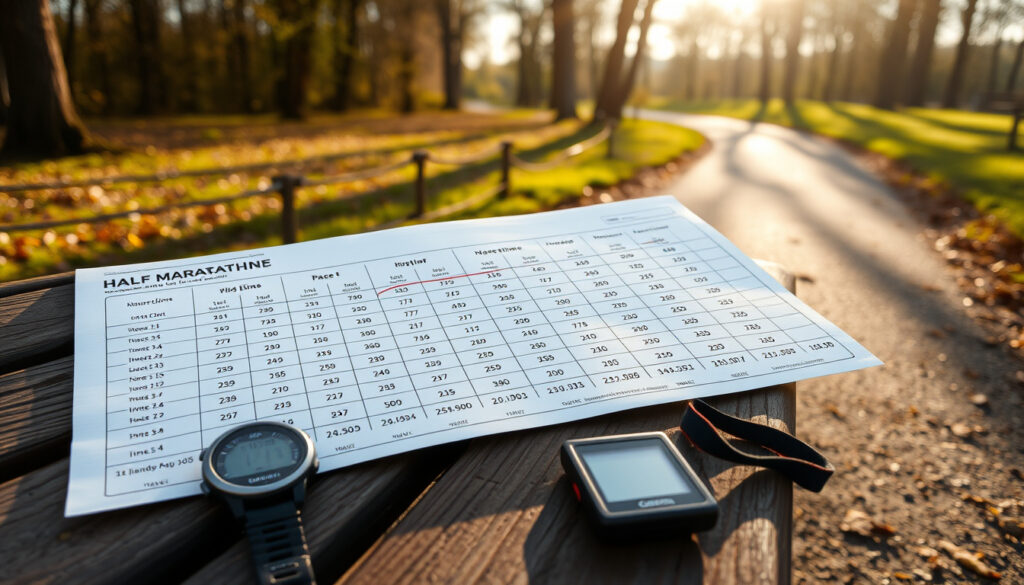
Half Marathon Pace Chart Km – Km Splits for Every Finish Time
What Pace Do You Need for Common Half Marathon Finish Times?
Whether you’re targeting your first finish or chasing a personal best, knowing your required pace per kilometer forms the foundation of every half marathon strategy. A half marathon covers 21.1 kilometers, and understanding how to translate your goal time into a consistent per-kilometer pace helps you avoid the two most common race-day mistakes: starting too fast and fading in the final miles.
Coaches and pace calculators agree that breaking the distance into manageable kilometer splits provides mental clarity and measurable checkpoints throughout the race. The math is straightforward: divide your target finish time by 21.1 to get the pace you need to hold in minutes and seconds per kilometer.
For example, a two-hour half marathon requires maintaining approximately 5:41 per kilometer. A 1:45 finish demands roughly 4:59 per kilometer, while elite runners chasing a sub-90-minute time must sustain around 4:15 per kilometer or faster.
Key Insights for Half Marathon Pacing
- Even pacing typically produces faster finish times than positive splits (going out fast and slowing down)
- Negative split strategies—running the second half slightly faster—can yield significant time savings for experienced runners
- Add 3-5 seconds per kilometer as an early-race buffer to account for adrenaline and crowded starting corrals
- Weather conditions may require adjusting your target pace by 5-10 seconds per kilometer
- Elevation gain adds roughly 6-12 seconds per kilometer for every 30 meters of climbing
- Track your splits every 5 kilometers during training runs to identify pacing consistency
- Use printable pace charts during races for quick reference at aid stations
Snapshot: Paces Across the Fitness Spectrum
| Pace (min/km) | Finish Time | Level |
|---|---|---|
| 4:15 | 1:29:42 | Elite |
| 4:30 | 1:34:58 | Advanced |
| 5:00 | 1:45:30 | Competitive |
| 5:30 | 1:56:03 | Intermediate |
| 6:00 | 2:06:36 | Developing |
| 6:30 | 2:17:09 | Beginner |
Half Marathon Pace Chart in Kilometers (Full Table)
Below is a comprehensive pace chart translating common half marathon finish times into per-kilometer splits. These figures assume flat terrain and moderate conditions. The table includes cumulative splits at key checkpoints to help you gauge your progress during the race.
| Finish Time | Per-KM Pace | 5K Split | 10K Split | Halfway | 21.1K |
|---|---|---|---|---|---|
| 1:25:00 | 4:01 | 20:07 | 40:15 | 42:30 | 1:25:00 |
| 1:30:00 | 4:15 | 21:18 | 42:36 | 45:00 | 1:30:00 |
| 1:35:00 | 4:30 | 22:30 | 45:01 | 47:30 | 1:35:00 |
| 1:40:00 | 4:44 | 23:42 | 47:27 | 50:00 | 1:40:00 |
| 1:42:00 | 4:50 | 24:12 | 48:26 | 51:00 | 1:42:00 |
| 1:45:00 | 4:59 | 24:57 | 49:56 | 52:30 | 1:45:00 |
| 1:50:00 | 5:13 | 26:07 | 52:15 | 55:00 | 1:50:00 |
| 1:55:00 | 5:27 | 27:17 | 54:35 | 57:30 | 1:55:00 |
| 2:00:00 | 5:41 | 28:28 | 56:56 | 1:00:00 | 2:00:00 |
| 2:05:00 | 5:56 | 29:38 | 59:17 | 1:02:30 | 2:05:00 |
| 2:15:00 | 6:24 | 32:01 | 1:04:03 | 1:07:30 | 2:15:00 |
| 2:30:00 | 7:07 | 35:36 | 1:11:12 | 1:15:00 | 2:30:00 |
For those seeking a downloadable version, McMillan Running provides a printable pace chart in PDF format showing cumulative splits for every kilometer.
Print your pace chart and pin it to your race bib or save it on your watch face. Check your splits every 5 kilometers during the race—if you’re running more than 10 seconds per kilometer ahead of or behind your target pace, adjust accordingly before fatigue sets in.
What Is a Good Half Marathon Pace Per Kilometer?
Defining a “good” pace depends on your fitness level, running experience, and training background. What feels comfortable for an experienced runner may be an unrealistic target for someone completing their first 21.1-kilometer race.
Beginner Benchmark: Sub-2:00 Finish
Runners newer to the distance typically target a sub-two-hour finish, which requires maintaining approximately 5:41 per kilometer. This pace assumes a consistent running base of at least 20-30 kilometers per week. For those building from a sedentary lifestyle, a walk-run approach with 5:50-6:30 per kilometer is a realistic starting point.
According to training guidelines for beginners, focusing on time rather than distance during early training runs helps build endurance without the intimidation of specific kilometer targets.
Intermediate Benchmark: 1:45 to 2:00
Runners with six months or more of consistent training often target the 1:45 to 2:00 window. A 1:45 finish requires 4:59 per kilometer—a pace that typically corresponds to a 20-22 minute 5K or 40-44 minute 10K in training. This range represents a significant achievement and indicates solid cardiovascular fitness.
Advanced and Elite Benchmarks
Athletes with several years of structured training may pursue times under 1:30, which demands 4:15 per kilometer or faster. Elite amateur runners and professionals target sub-90-minute finishes, requiring sustained paces below 4:15 per kilometer. World-record pace for the half marathon translates to approximately 2:47 per kilometer, though such performances remain beyond the scope of recreational racing.
Age, gender, and environmental conditions all influence what constitutes a realistic target. Race-equivalent predictors like VDOT calculations, as used by SmartPace prediction tools, account for these variables by extrapolating from your recent race performances.
How to Calculate and Use Your Half Marathon Pace
Calculating your target pace requires basic arithmetic and an understanding of how to convert hours into minutes. The formula is simple: convert your goal time to total minutes, then divide by 21.1 kilometers.
The Basic Calculation
For a 2:00:00 target finish, convert two hours to 120 minutes. Divide 120 by 21.1 to get approximately 5:41 per kilometer. For a 1:45:00 target, convert to 105 minutes and divide by 21.1, yielding roughly 4:59 per kilometer.
The Marathon Handbook pace calculator automates these conversions and generates complete split tables for any target time.
Pace Bands and Negative Split Strategies
Experienced runners often employ negative split strategies, starting slightly conservatively and accelerating through the second half. For a 1:45 target, this might mean beginning at 5:05 per kilometer for the opening kilometers and building to 4:55 per kilometer by kilometer 15.
Even split strategies work well for beginners—holding the same pace throughout creates predictable energy demands and avoids the glycogen depletion that causes late-race slowdown. Most half marathon pace charts from RunHive include suggested bands for both approaches.
Account for elevation changes when planning your splits. Each 30 meters of climbing adds approximately 6-12 seconds per kilometer to your effective pace. Similarly, hot temperatures and humidity may require slowing your target pace by 5-10 seconds per kilometer to avoid overheating.
Kilometer Milestones: Pacing Through the Distance
Breaking the half marathon into recognizable landmarks provides mental relief during the race. Use these cumulative split times as checkpoints to evaluate whether you’re on pace.
- Kilometer 5 (5K): First major checkpoint. Your time here indicates whether you’ve started appropriately conservatively. Target times: 25:00 for 1:45 finish, 28:25 for 2:00 finish.
- Kilometer 10 (10K): The halfway mental barrier. Many runners report this is where doubt sets in if pacing was too aggressive early. Target times: 50:00 for 1:45 finish, 56:50 for 2:00 finish.
- Kilometer 15: Entering the unknown territory for first-timers. Your body begins signaling fatigue. Target times: 1:15:00 for 1:45 finish, 1:25:30 for 2:00 finish.
- Kilometer 18: The “wall” zone. Focus on one kilometer at a time. Target times: 1:30:00 for 1:45 finish, 1:42:00 for 2:00 finish.
- Kilometer 21.1 (Finish): Congratulations—you’ve completed 21.1 kilometers. Celebrate your target time.
For a complete breakdown of cumulative splits, The Running Channel pace chart provides detailed per-kilometer times for paces ranging from elite to beginner levels.
Established Facts and Areas of Uncertainty
Understanding what science and experience have confirmed—versus what remains variable—helps set realistic expectations.
| Established (Reliable) | Variable (Adjust as Needed) |
|---|---|
| 21.1 km is the standardized half marathon distance | Exact pace adjustments for heat and humidity |
| Even splits generally outperform positive splits | Individual fitness adaptation to pacing strategy |
| The mathematical formula for pace calculation is exact | Impact of elevation on individual runners |
| Negative splits can save energy for the finish | Optimal buffer time at race start |
| 5K and 10K race times predict half marathon potential | Long-term training adaptation rates |
Context: How Half Marathon Pacing Fits Into Training
Pace charts serve as planning tools rather than rigid prescriptions. Effective training integrates these targets through structured workouts including tempo runs, interval sessions, and long runs at or near goal race pace.
Most training plans build toward your target pace gradually. The final three to four weeks before race day should include practice efforts at goal pace, helping your body adapt to the specific physiological demands. Your Exact Conversion Chart approach to pace understanding means you can cross-reference different race distances to build a comprehensive fitness picture.
Physiologically, half marathon pace sits between your 10K race pace (approximately 10-15 seconds per kilometer slower) and your marathon race pace (approximately 10-15 seconds per kilometer faster). This positioning makes the half marathon accessible to runners who have built a solid aerobic base.
Sources and Methodology
This guide draws on established pace prediction models and practical coaching experience. Key methodologies include the McMillan Running calculator, which uses race-equivalent calculations based on VDOT principles, and SmartPace prediction charts that extrapolate half marathon performance from shorter race times.
“The goal isn’t to run the fastest pace you can hold for 21 kilometers—it’s to run the pace that best matches your current fitness while accounting for the variables of race day.”
For Exact Processing Times regarding pace calculations and their verification, consult the methodology sections of McMillan Running and RunHive, both of which provide transparent calculation frameworks.
Summary
Understanding your target pace per kilometer forms the cornerstone of half marathon preparation. Whether you’re aiming for a sub-90-minute elite performance or a comfortable sub-2:30 finish, the calculation remains the same: divide your goal time by 21.1. Use the pace charts above to identify your target, practice that pace during training, and execute even or slightly negative splits on race day for optimal results.
Frequently Asked Questions
How fast is 5:00 min/km for a half marathon?
Running consistently at 5:00 per kilometer yields a finish time of approximately 1:45:30. This pace falls into the competitive category, suitable for runners with solid training backgrounds.
What pace for a 4:30 min/km half marathon?
Sustaining 4:30 per kilometer results in a 1:34:58 finish. This pace represents the advanced to elite level, requiring significant training volume and natural ability.
How do I calculate half marathon pace from a 10K time?
Your half marathon pace will be approximately 10-15 seconds per kilometer slower than your 10K race pace. For example, a 50-minute 10K (5:00/km) suggests a 1:50-1:55 half marathon potential.
What is a good half marathon pace for a beginner?
A sub-2:00 finish (5:41/km) represents a solid beginner achievement. Many first-time half marathon runners target 2:15-2:30, requiring 6:24-7:07 per kilometer.
How do negative splits work in a half marathon?
Negative splits involve running the second half faster than the first. For a 1:45 target, you might start at 5:05/km and finish at 4:55/km, banking energy early and finishing strong.
Should I add buffer time to my pace calculation?
Most coaches recommend adding 3-5 seconds per kilometer in the opening kilometers to account for crowded starts and race-day adrenaline. Adjust this buffer based on your experience and the race’s field size.
How does elevation affect half marathon pace?
Each 30 meters of elevation gain adds approximately 6-12 seconds per kilometer. For a 100-meter elevation gain over the course, expect your effective pace to slow by 20-40 seconds per kilometer.
More related posts
 Apple iPhone 16 Pro Max: Price, Specs & Value in Ireland
 Spa Pool New Zealand 2025: Prices, Costs & Rules
 Coffee Grounds for Garden: Science-Based Benefits and How to Use
 Night Agent Season 3: Release Date, Cast, Rose Status
 Season of the Witch: Song, Film, and Meaning
 Rod Stewart’s ‘I Don’t Want to Talk About It’ – Full Story
 A Nightmare on Elm Street: Facts and Banned Sequel
 Reserve Bank OCR Delay: Next Announcement Dates & Updates